
In the 2026 construction landscape, equipment procurement has evolved beyond simple price tags. For fleet managers and contractors, the decision to buy vs rent excavator can make or break a project’s profitability. Whether you are expanding your fleet or starting a specific short-term contract, evaluating the buy vs rent excavator dilemma requires a deep dive into your project timeline, financial health, and risk tolerance.
This guide breaks down the three primary acquisition paths—Buying New, Renting, and Buying Used—to help you find the optimal balance for your business.
Table of Contents
Scenario Analysis: Matching the Machine to the Mission
When to buy vs rent excavator is often determined by the “60% Rule”: if you anticipate using the machine more than 60% of the year, ownership is typically the more cost-effective route.
- Short-term (1–4 Months): Renting is the clear winner. It allows you to access specialized machines (like long-reach or mini excavators) without a long-term commitment.
- Medium-term (5–12 Months): This is the “grey zone.” Here, the buy vs rent excavator choice depends on your future project pipeline. If your backlog is strong, purchasing is better; if uncertain, stick to rental.
- Long-term (12+ Months): Ownership wins. Building equity in an asset is far superior to paying recurring rental fees that offer zero residual value.
Financial Comparison: Cash Flow & ROI
The financial impact of the buy vs rent excavator choice shows up clearly in your monthly cash flow. Let’s look at a typical 20-ton class excavator case study.
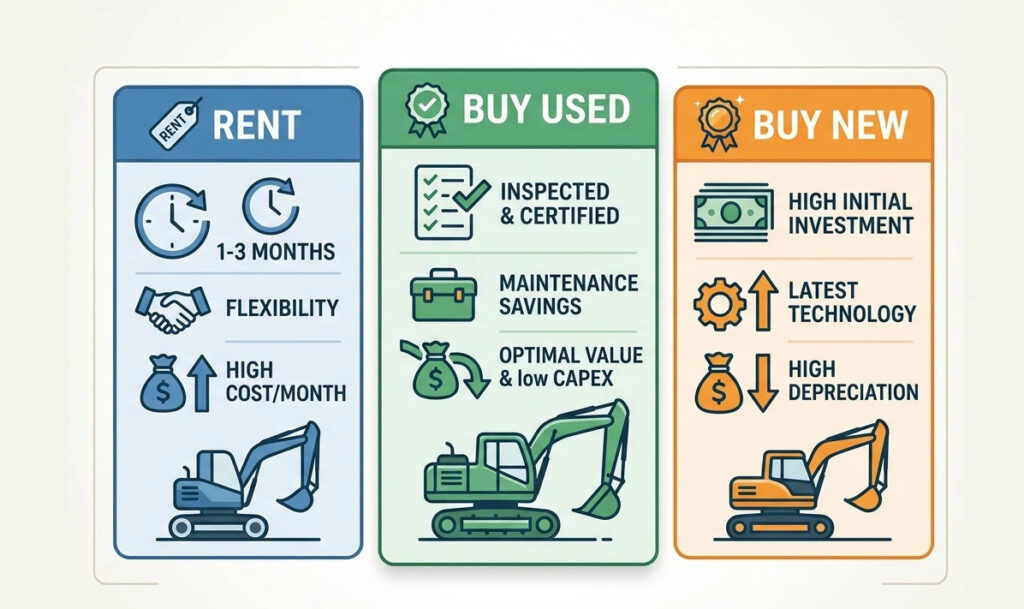
The Total Cost of Ownership (TCO)
Comparing buy vs rent excavator costs involves looking at more than just the monthly payment. You must consider the Total Cost of Ownership (TCO), which includes depreciation, insurance, and taxes.
| Acquisition Method | Monthly Cash Outflow | Equity Building | Maintenance Responsibility |
| Renting | High ($5,000 – $7,000) | None | Rental Company |
| New Purchase | Moderate ($3,500 – $4,500*) | High | Owner |
| Used Purchase | Low ($2,000 – $2,800)* | Moderate | Owner |
*Estimated financing payments based on current 2026 construction equipment financing rates.
For companies focused on Heavy Equipment Fleet Management, buying used often provides the fastest Return on Investment (ROI) because the initial steep depreciation (often 20-40% in the first two years) has already been absorbed by the first owner.
Risk Assessment: Funds, Maintenance, and Flexibility
Risk management is a critical pillar of the buy vs rent excavator debate. Each method has its own “hidden” exposures.
- Renting Risks: Lack of availability during peak seasons and zero control over the machine’s maintenance history.
- New Purchase Risks: High capital expenditure (Capex) that can tie up your credit lines and limit your ability to bid on other projects.
- Ownership Risks: The primary concern for owners is maintenance. This is why a professional Used Excavator Inspection is non-negotiable before any purchase.
By opting for a used machine, you gain the flexibility of ownership without the crippling debt of a new unit. If a project ends unexpectedly, a used machine is much easier to resell or trade in without taking a massive financial hit.
The Balanced Choice: Why Certified Used Equipment Wins
A strategic middle ground in the buy vs rent excavator spectrum is purchasing certified used equipment. But is buying a used excavator worth it? The answer is yes—if you follow a strict verification process.
The “sweet spot” for many contractors in 2026 is a machine that is 3 to 5 years old. To mitigate the risk of downtime, we recommend a 100-point Used Excavator Inspection that covers hydraulic pressure, engine blow-by, and structural integrity of the swing motor and tracks.
Choosing a reputable supplier that provides detailed inspection reports allows you to enjoy the low monthly costs of a used machine with the reliability of a newer one. It is the most effective way to scale your fleet while keeping your balance sheet lean.
Many contractors resolve the buy vs rent excavator conflict by opting for pre-owned machines, as it allows them to own two high-quality used units for the price of one new machine.
Conclusion
Ultimately, the buy vs rent excavator choice should align with your 2026 business goals. If you value flexibility above all else, rent. If you have the capital and need the latest tech, buy new. However, for the majority of growing businesses, buying a certified used excavator provides the best balance of low risk, low cost, and high asset value.
Ready to explore high-quality used options? Contact our team for a comprehensive inspection report on our current inventory.
FAQ
What is the main factor in the buy vs rent excavator decision?
Utilization rate. If you use it less than 60% of the time, rent it.
Is there a general rule for buy vs rent excavator?
Yes. Rent for specific, one-off tasks; buy (used or new) for your core, everyday work.
Are maintenance costs higher for used excavators?
Slightly, but the lower purchase price usually offsets these costs for several years.
Can I finance a used excavator?
Yes, most Construction Equipment Financing companies offer competitive rates for