
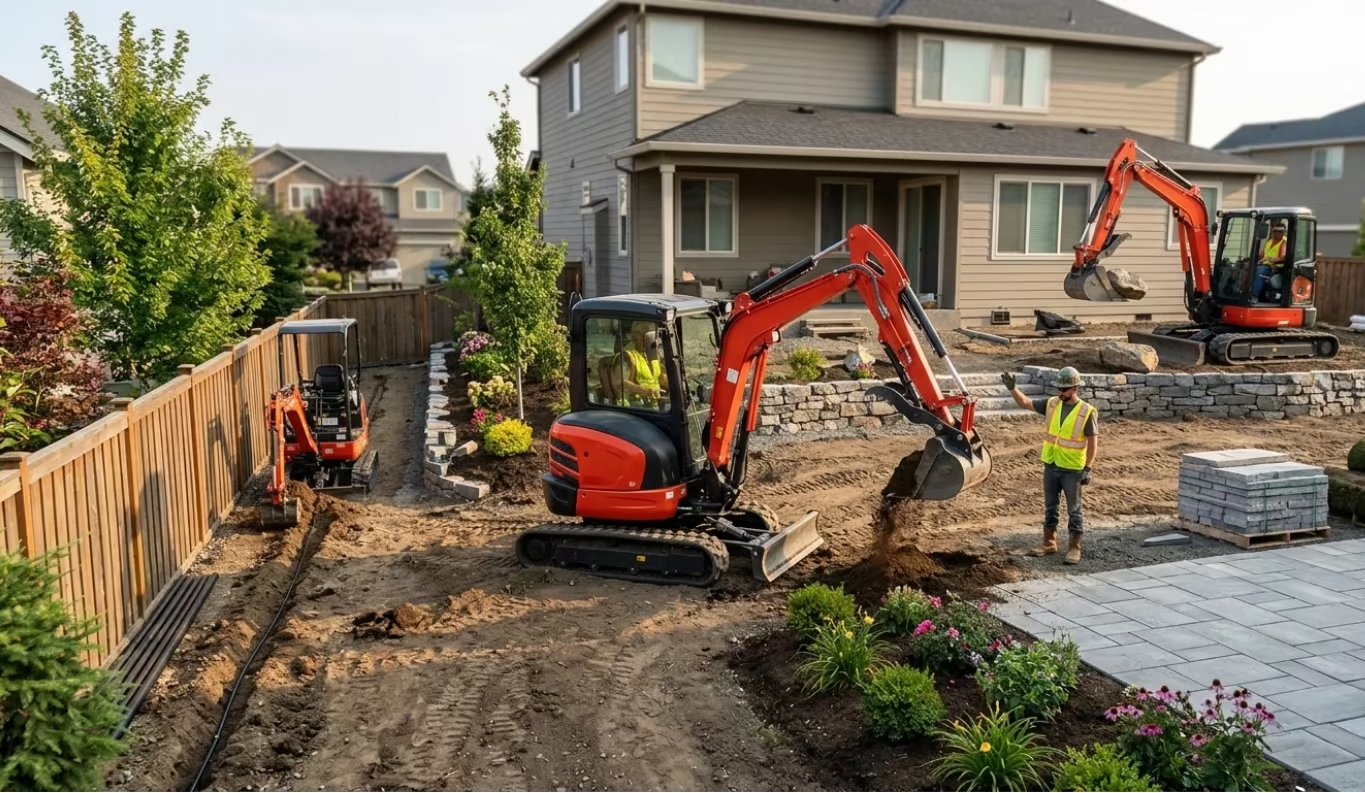
The landscaping industry is currently navigating a perfect storm of labor shortages and rising client expectations for “instant” transformations. For business owners, the transition from manual labor to mechanization isn’t just a luxury—it’s a survival strategy. While large excavators are staples on civil sites, the specialized needs of residential and commercial green spaces have birthed the era of the Landscaping mini excavator. These compact powerhouses are designed to do what human crews can’t: work tirelessly for 10 hours straight without a drop in efficiency, all while fitting through a 36-inch garden gate.
In modern site preparation, the precision of a machine often outweighs the flexibility of a shovel. Whether you are dealing with high-density urban backyards or sprawling estate renovations, selecting the right tonnage for the job is the difference between a profitable project and a logistical nightmare. This guide breaks down why the Landscaping mini excavator has become the industry standard for contractors who value speed, safety, and a clean finish.
Table of Contents
Tight Access Mastery: The 1.0t to 1.2t Revolution
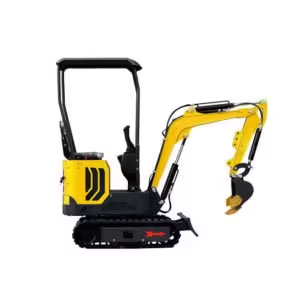
The most significant bottleneck in residential landscaping is access. Most urban properties feature side gates designed for lawnmowers, not machinery. This is where the 1.0-ton and 1.2-ton models shine. These “micro” units often feature retractable undercarriages, allowing them to shrink to less than 800mm in width to navigate narrow alleys.
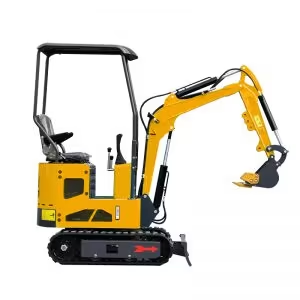
Using a mini excavator for backyard landscaping projects at this scale allows contractors to bid on jobs that were previously “manual only.” Instead of a crew of four spending two days digging a pool foundation or a trench for irrigation, a 1.2t unit can complete the task in a fraction of the time. Despite their small footprint, these machines offer enough breakout force to handle compacted clay and rocky subsoil that would break a laborer’s spirit.
Technical Citation: According to Landscape Management, mechanization in residential sectors has increased productivity by over 40% in tight-access sites over the last five years.
Precision Yard Grading and Drainage Control
Proper drainage is the foundation of any long-lasting landscape. Without accurate Yard grading, a beautiful garden can quickly become a swamp, leading to dead turf and property damage claims. The Landscaping mini excavator provides the hydraulic stability required to create subtle 1% or 2% slopes that ensure water flows away from a home’s foundation.
For mid-sized projects, the 1.5-ton to 2.0-ton range is the “sweet spot.” A 1.8t model, for instance, offers the perfect balance of reach and ground pressure. Because these machines utilize rubber tracks, they distribute their weight effectively, ensuring that they don’t crush existing drainage pipes or leave deep ruts in established lawns. When you are Using a mini excavator for backyard landscaping projects, the ability to rotate 360 degrees while grading allows for a “clean-as-you-go” workflow that keeps the site organized and safe.
Heavy Lifting and the Stump Removal Excavator
When a project moves from “planting” to “clearing,” the power requirements shift. Removing old growth or installing large-scale hardscapes like retaining walls requires sheer hydraulic force. If your company focuses on site clearing, you are likely looking for a stump removal excavator in the 2.5t to 3.5t range.
A 3.5-ton Landscaping mini excavator brings industrial-grade power to the backyard. Equipped with a hydraulic thumb attachment, it transforms from a digging tool into a versatile crane. This weight class is essential for:
1.Placing “one-man” or “two-man” boulders for rock gardens.
2.Uprooting deep-seated stumps without excessive soil disturbance.
3.Operating high-flow attachments like brush cutters or heavy-duty augers.
By utilizing a dedicated stump removal excavator, you reduce the risk of injury associated with manual stump grinding or winching, which are notorious for causing workplace accidents in the landscaping sector.
Selecting the Right Tonnage: A Comparative Analysis
Not every job requires the same level of force. Over-specifying your machine leads to unnecessary fuel consumption and potential site damage, while under-specifying leads to mechanical strain.
| Tonnage | Primary Application | Best Landscape Feature |
| 1.0t – 1.2t | Narrow access, indoor/courtyard | Retractable tracks for 30″ gates |
| 1.5t – 1.8t | General Yard grading, trenches | Most versatile “all-rounder” |
| 2.0t – 2.5t | Medium hardscaping, pool prep | Higher lift capacity for stone |
| 3.0t – 3.5t | Stump removal excavator tasks | Maximum breakout force for clearing |
The ROI of the Landscaping Mini Excavator
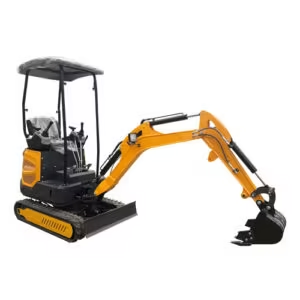
The financial logic behind purchasing a Landscaping mini excavator is rooted in “man-hour displacement.” If a 1.8t machine costs approximately $25,000 to $35,000, and it replaces the work of three manual laborers, the machine pays for itself in less than one full season of operation. Furthermore, a machine doesn’t get tired at 3:00 PM on a Friday.
When Using a mini excavator for backyard landscaping projects, you also gain a marketing edge. Modern clients are impressed by professional-grade equipment. It signals that your company is efficient, technologically advanced, and capable of handling complex engineering tasks like structural retaining walls or tiered gardens. The Landscaping mini excavator is, in effect, a rolling billboard for your company’s professionalism.
Technical Features That Matter: Zero-Tail Swing and Rubber Tracks
For the landscaping professional, “Zero-Tail Swing” (ZTS) is a game-changer. Standard excavators have a counterweight that extends beyond the tracks when the cab rotates. In a tight backyard, this leads to dented siding or smashed fences. A ZTS Landscaping mini excavator keeps its entire body within its track width, allowing the operator to focus entirely on the bucket without worrying about what’s behind them.
Additionally, track technology has evolved. While steel tracks are standard in mining, the Landscaping mini excavator almost exclusively uses rubber tracks. This is critical for damage mitigation. A 2.5t machine on rubber tracks has a lower “pounds per square inch” (PSI) on the ground than an average adult male standing on one foot. This allows you to drive over driveways and sidewalks without the fear of cracking expensive concrete or paving stones.
echnical Citation: For specific ground pressure data and safety standards, refer to the Association of Equipment Manufacturers (AEM) guidelines on compact machinery.
Maintenance and Long-Term Reliability
To keep your Landscaping mini excavator as a profit center, maintenance cannot be ignored. Daily checks of the hydraulic fluid levels and track tension are mandatory. Because these machines often work in dusty or muddy environments, cleaning the radiators and greasing the pivot points every 10 hours of operation will prevent the “pin-slap” that ruins accuracy over time.
Investing in a machine from a reputable supplier ensures that when a hydraulic hose eventually blows—as they all do—you have access to spare parts. A Landscaping mini excavator that sits in the shop during the peak of the spring season is a liability. Choose models with accessible engine bays (like those in the 1.5t – 2.0t range) to make field repairs easier for your crew.
Conclusion
The demand for high-end outdoor living spaces shows no signs of slowing down. As designs become more complex, the tools required to build them must evolve. The Landscaping mini excavator is the bridge between a simple lawn care service and a high-revenue landscape construction firm. By matching the right tonnage—from the gate-friendly 1.0t to the stump-crushing 3.5t—to your specific project needs, you ensure every bid you submit is backed by the most efficient technology available.
Own your site, protect your crew, and maximize your margins by making the Landscaping mini excavator the heartbeat of your next project.
Ready to upgrade your fleet? Explore our full range of 1.0t to 3.5t models at Huaying Machinery and find the perfect landscaping mini excavator to turn your toughest backyard projects into effortless profit.
FAQ
Do I need a special license to operate a Landscaping mini excavator?
In most regions, no commercial driver’s license (CDL) is required for operation on private property, but most states require a standard driver’s license if you are towing the machine on a trailer.
Can a 1.0t machine really handle Yard grading?
es, for small gardens. However, for large-scale Yard grading, a 1.8t or 2.0t unit is recommended for better stability and a wider grading blade.
Is a stump removal excavator different from a regular one?
It’s the same machine, but it requires a “Thumb” attachment and usually a higher tonnage (2.5t+) to provide the necessary lifting and prying power.
Will the machine ruin my customer’s lawn?
While rubber tracks minimize damage, any heavy machine can leave marks on wet soil. Using “ground mats” or plywood paths is a professional way to ensure a zero-impact site.
How do I transport a 3.5t Landscaping mini excavator?
A 3.5t machine usually requires a heavy-duty dual-axle trailer and a 3/4-ton pickup truck (like an F-250 or equivalent) to safely handle the towing capacity.