
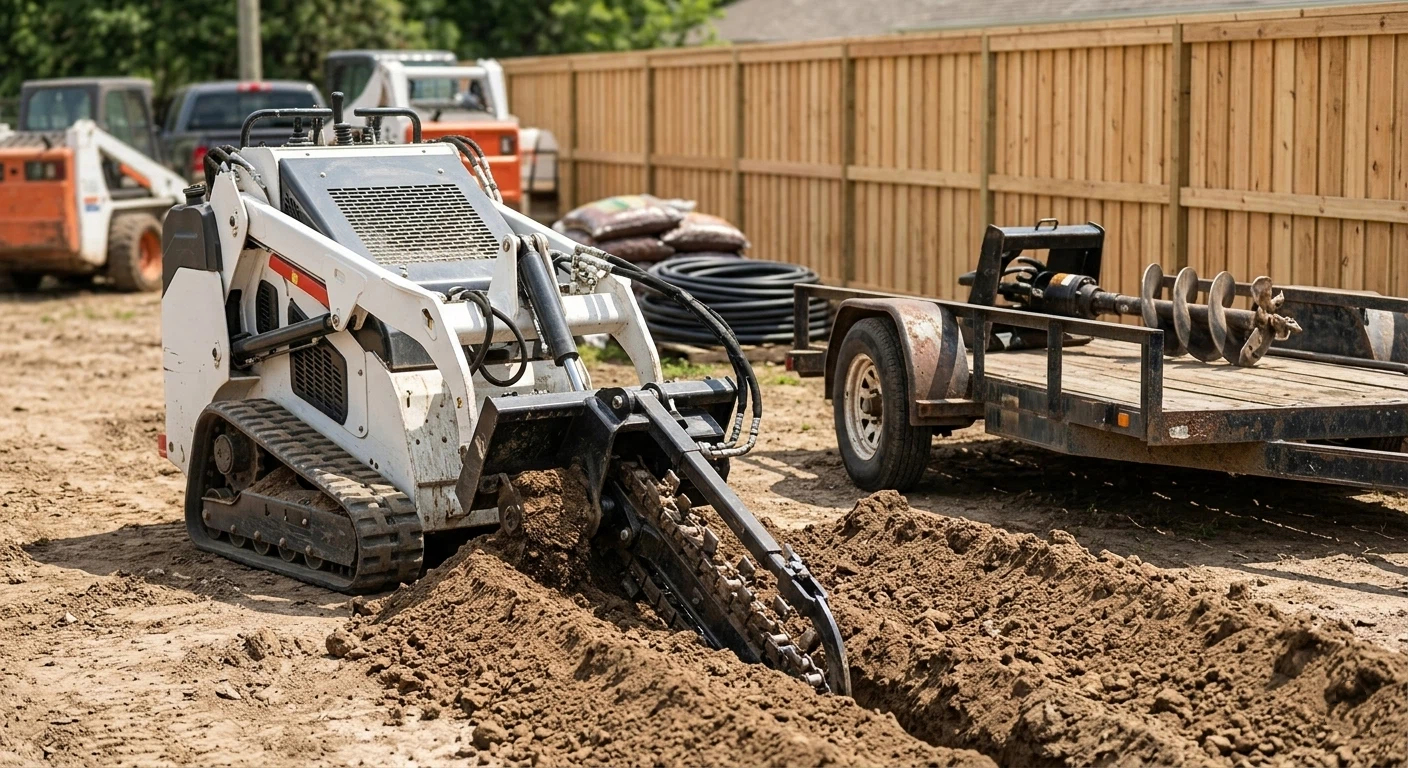
If you are running an outdoor contracting or landscaping business, your compact loader is likely one of your largest capital investments. Yet, if you are only using it with a standard bucket to scoop mulch and move gravel, that machine is essentially acting as an expensive mechanical wheelbarrow while high-margin project revenue slips away to your local competitors.
Unlocking the true earning potential of your existing fleet comes down to diversifying your capabilities with specialized mini skid steer attachments. This guide breaks down the exact operational roadmap to leverage these high-torque tools so you can stop turning down lucrative fencing, utility, and drainage contracts, eliminate your dependence on hard-to-find manual labor, and dramatically scale your weekly invoicing.
Table of Contents
Why Adding Mini Skid Steer Attachments is the Fastest Way to Expand Your Landscaping Business
Many owner-operators fall into the trap of treating their small loaders as nothing more than motorized wheelbarrows. While a bucket helps transport material across a jobsite, it restricts your billable hourly rate to low-margin tasks that face heavy price undercutting from local competitors. The real profit in residential and commercial property development is found in specialized subsurface work, such as digging utility lines, setting privacy fence lines, and boring structural deck footings. If your fleet lacks specialized mini skid steer attachments, you are structurally locked out of these high-ticket projects.
By investing in professional-grade mini skid steer attachments, you instantly shift your business model from a low-margin general laborer to a specialized site-preparation subcontractor. This change allows you to demand flat-rate project pricing rather than trading your limited hours for low field wages. When you can execute precise trenching or deep hole drilling from the comfort of a machine platform, your daily earning potential scales exponentially.

According to data tracked by the U.S. Bureau of Labor Statistics (BLS), trade labor wages and employer liabilities continue to rise steadily, squeezing the profit margins of small companies. You can review the exact operational overhead metrics in the BLS Employer Costs for Employee Compensation Summary. To maintain a healthy bottom line, successful operators are aggressively replacing manual shovel crews with dedicated machine-driven solutions. Expanding your utility fleet with targeted tool options ensures your company stays highly agile, profitable, and independent of volatile labor markets.
Calculating the Daily Revenue of a Skid Steer Auger and Trencher Setup
When evaluating which specific add-ons drive the highest daily revenue for an outdoor contractor, a heavy-duty skid steer auger and trencher system offers the fastest timeline to full capital recovery. These two mechanical systems address the most labor-intensive, physically demanding phases of outdoor construction projects. By automating these tasks, you radically compress your project timelines and free up your schedule to book more clients each month.
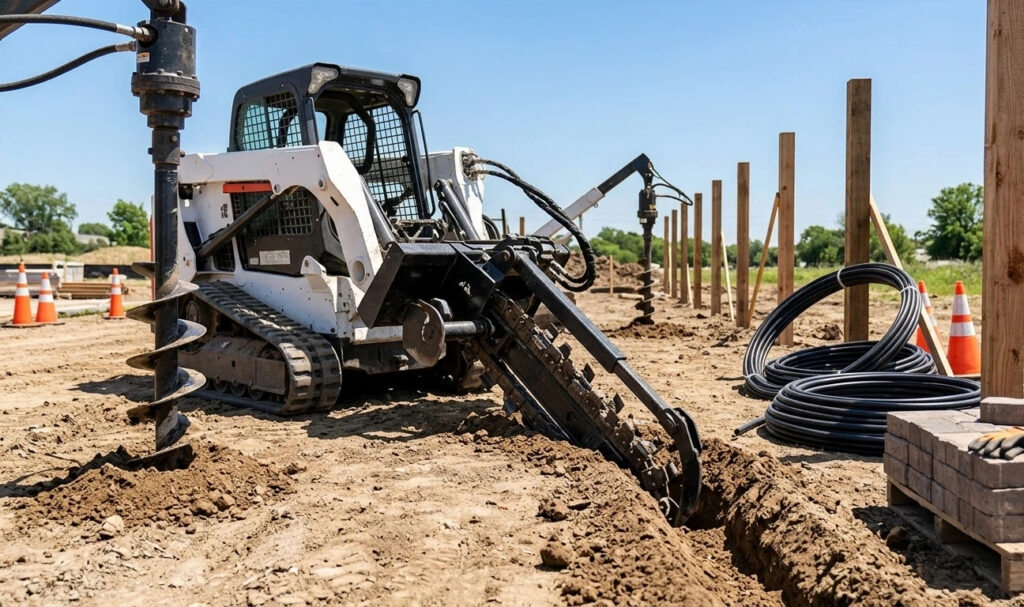
An industrial planetary auger drive converts your loader’s auxiliary hydraulic power into raw, unyielding rotational torque. When faced with hard-packed clay, dense rocky gravel, or frozen topsoil, manual hand augers or manual post-hole diggers slow your field progress to a crawl. A heavy-duty planetary auger slice through these underground obstructions in seconds, keeping your structural fence line perfectly straight and deep enough to pass local frost-line building inspections.
Directly complementing the drilling drive is the continuous-chain trencher tool. For backyard drainage mitigation, underground electrical line placement, and commercial lawn irrigation networks, a dedicated trencher delivers a level of speed that manual crews cannot match. The tool leaves behind a clean, vertical-walled trench with a smooth, completely cleared bottom. This high-precision finish eliminates the need for tedious manual clean-out work before your team can safely lay down pipe or conduit.
Integrating this type of commercial skid steer auger and trencher capability means your loader works non-stop through multiple stages of a project. For instance, you can use a high-torque planetary auger to sink perimeter fence posts in the morning, change tools in under two minutes via a standard quick-attach interface, and spend the afternoon carving out several hundred feet of electrical runs with the trencher. Every hour your machine runs these specialized mini skid steer attachments instead of sitting on a trailer represents pure billable profit. Upgrading to high-torque mini skid steer attachments removes the physical bottleneck from your daily schedule, enabling you to finish jobs twice as fast.
Unlocking High-Ticket Bids with Professional Landscaping Attachments for Small Loaders
Securing municipal contracts, commercial property maintenance accounts, and premium residential hardscape bids requires extreme schedule consistency and minimal turf disruption. Large, heavy excavators or full-sized track loaders frequently crush manicured lawns, crack concrete driveways, and cannot pass through standard backyard gates. This operational constraint is exactly why utilizing professional landscaping attachments for small loaders provides a massive competitive advantage.
A narrow-track mini loader paired with compact, specialized tools exerts low ground pressure while delivering commercial-grade digging forces. You can navigate between tight residential property lines, operate beneath low-hanging tree canopies, and execute deep excavations without destroying existing turf. This clean operation protects your brand reputation and minimizes expensive, time-consuming yard restoration costs at the end of a project.
| Tool Selection | Project Application | Daily Output Comparison | Net Margin Profile |
| Planetary Auger | Fencing, Deck Footings, Tree Planting | 60+ Holes drilled per day | High (Replaces 3 hand laborers) |
| Chain Trencher | Irrigation, French Drains, Utility Lines | 500+ Linear feet cut per day | High (Zero manual clean-out needed) |
Deploying professional landscaping attachments for small loaders guarantees a level of structural consistency that manual digging simply cannot match. A machine-driven trench preserves a perfectly uniform depth across its entire run, making it easy to comply with local plumbing and drainage slope codes. When you operate high-efficiency mini skid steer attachments, your final build quality climbs significantly, allowing you to charge premium rates for your services.
Furthermore, owning a versatile suite of mini skid steer attachments allows you to adjust to changing soil profiles on the fly. Whether you are dealing with hard-packed clay or rocky glacial till, having the right hydraulic tools keeps your crew moving forward without losing valuable billable hours. This adaptability turns your small machine into an all-in-one site solution that can handle grading, drilling, and trenching back-to-back.
Labor Shortage Solutions: The ROI of Running Heavy-Duty Mini Skid Steer Attachments
Managing a large field crew introduces significant administrative overhead, high insurance liabilities, and the constant headache of field supervision. Transitioning your field operations to rely on rugged mini skid steer attachments lets you build a lean, incredibly profitable “One-Man Crew” model. By shifting your reliance from unpredictable labor to high-output mechanical assets, you stabilize your operating costs and maximize your take-home margins.
Let’s look at the raw productivity metrics. A three-man manual crew using traditional hand shovels might spend a full eight-hour day digging and pouring fifteen fence post holes. By comparison, a single solo operator running optimized mini skid steer attachments can easily drill sixty identical post holes in less than half that time. The machine doesn’t slow down in the mid-afternoon heat, doesn’t call in sick, and adds zero dollars to your hourly payroll liabilities.
To minimize workplace injury claims and lower your business insurance premiums, mechanical substitution is the smartest move you can make. The National Institute for Occupational Safety and Health (NIOSH) explicitly highlights that replacing manual digging tasks with compact mechanical tools drops the risk of severe lower-back musculoskeletal strain among construction workers. You can read the full ergonomic safety recommendations in the official NIOSH Simple Solutions for Construction Workers Report.
When your business relies on high-output mini skid steer attachments, the machinery absorbs the punishing physical impact of the soil, keeping your energy focused on client management and secure positioning for your next contract. Choosing to invest in premium mini skid steer attachments ensures that you can handle large-scale drainage or fencing contracts completely alone, keeping 100% of the labor margin for yourself. Every piece of your equipment lineup must function as a pure revenue generator. If you are shopping for new mini skid steer attachments, focus entirely on tools that directly replace slow hand labor. Selecting high-quality mini skid steer attachments allows you to out-pace larger companies while maintaining minimal operational overhead.
Final Verdict
Continuing to rely on slow, manual digging methods or turning down complex subsurface contracts caps your business growth and leaves you stuck bidding on low-margin residential maintenance tasks. Upgrading your service capacity with premium mechanical tools removes these growth limits completely. By pairing a high-torque planetary auger and a continuous chain trencher with your loader frame, you unlock immediate access to high-ticket utility line work, commercial privacy fencing contracts, and complex landscape drainage installations.
The long-term financial case for expanding your tooling options is simple. Rather than constantly struggling with labor shortages, rising hourly wages, and expensive jobsite management bottlenecks, you can leverage a single compact power unit to complete multi-man projects alone in a fraction of the time. This strategic operational agility allows you to easily out-bid larger, bloated construction crews while keeping a far higher profit margin on every linear foot of earth you move. Explore our complete line of industrial-grade mini skid steer attachments today, optimize your daily project speed, and secure your market share this season.
FAQ
What hydraulic flow specifications are required to run a mini skid steer auger and trencher effectively?
Most commercial attachments operate efficiently within a standard hydraulic flow window of 10 to 15 Gallons Per Minute (GPM). This hydraulic range delivers optimal torque and rotational cutting speed for popular mini loader platforms like the Bobcat MT100, Toro Dingo, and Ditch Witch.
How fast can a solo contractor recover the initial purchase cost of an auger or trencher?
In active contracting environments, a high-torque auger or continuous trencher completely pays for itself within its first 3 to 4 mid-sized fencing or landscape drainage installations. By eliminating outsourced digging subcontractors, the tool adds pure net profit to your bottom line immediately.
Which teeth configuration should I select for a mini trencher chain to handle difficult ground?
For standard loamy soil or clean turf, a classic cup-tooth style chain works best to scoop out loose dirt. However, if your local service territory features heavy clay, compacted gravel, or rocky conditions, you should upgrade to a combination chain that alternates between cup teeth and carbide-tipped rock teeth to maintain maximum forward digging speed.