
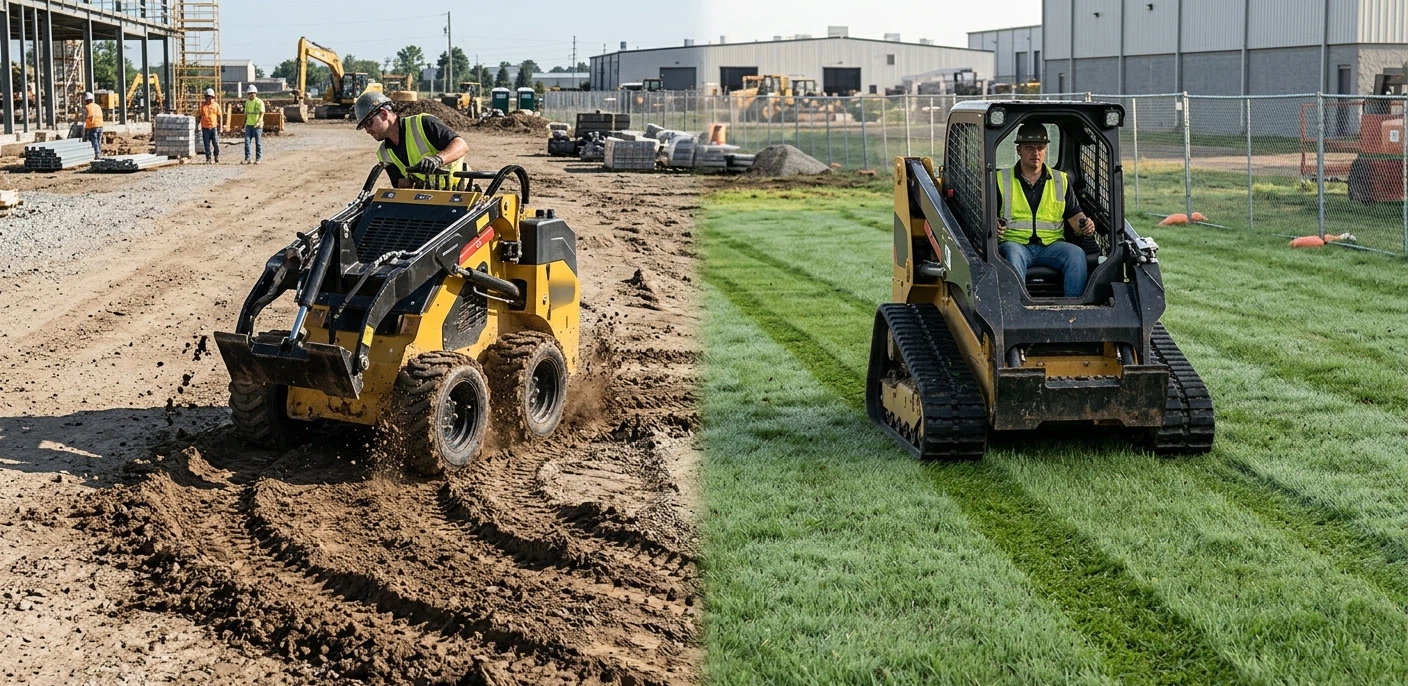
The decision between a wheeled unit and a tracked machine often feels like a gamble, but the stakes are measured in turf damage and downtime. For years, the industry has debated the merits of the mini skid steer vs CTL (Compact Track Loader), yet the answer remains elusive because it isn’t about which machine is “better”—it is about which footprint matches your soil.
In the compact equipment world, your choice dictates your efficiency. A machine that floats on a rain-soaked residential lawn might be the same machine that eats through its undercarriage on a concrete driveway. To make an informed choice, we have to look past the horsepower and dive into the physics of ground pressure and the mechanics of the drivetrain.
Table of Contents
How Mini Skid Steer vs CTL Impacts Ground Compaction
The most significant differentiator between these two platforms is the pounds per square inch (PSI) exerted on the substrate. A wheeled mini skid steer concentrates the entire weight of the machine and its load onto four small contact patches. In contrast, a CTL distributes that weight across the entire length and width of two rubber tracks.
According to data on soil compaction from the USDA Natural Resources Conservation Service,excessive ground pressure leads to reduced pore space in the soil, which stunts plant growthand ruins drainage. A typical wheeled unit might exert 30 to 50 PSI, whereas a CTL usuallyoperates in the 3.0 to 4.5 PSI range. This “flotation” allows a CTL to stay on top of soft mud ordelicate turf where a wheeled unit would immediately sink and create deep ruts.
When evaluating a mini skid steer vs CTL for utility work, you must ask: Is the ground I’m working on “finish-ready”? If you are working on an established estate where the grass must remain pristine, the low-impact footprint of a track system is your primary insurance against expensive remedial landscaping.
When Tires Outperform Tracks
While tracks win the “beauty contest” on soft grass, they often lose the war on the pavement. The very nature of a track system—the “scrubbing” effect—becomes its greatest weakness on asphalt or concrete. Every time a CTL turns, the rubber lugs are forced to drag across the hard surface, generating heat and friction that accelerates wear.
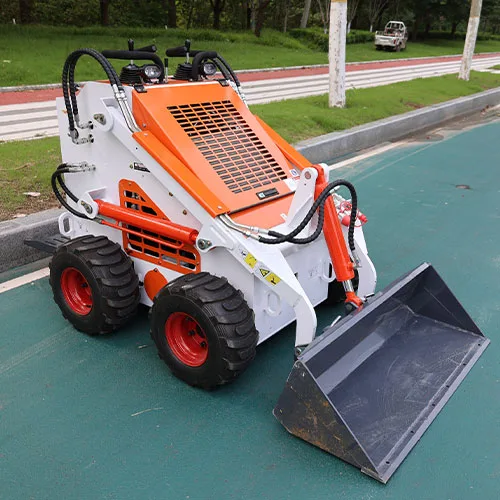
For municipal work or interior demolition where the surface is stable and abrasive, a wheeled mini skid steer vs CTL comparison quickly favors the wheels. Tires are designed to handle the friction of hard-surface “skidding” much more efficiently. Furthermore, a wheeled machine is generally faster in “straight-line” travel, making it the superior choice for material handling tasks that involve moving pallets or debris across a large, paved staging area.
The maintenance of a wheeled machine is also significantly simpler. A puncture can be pluggedor a tire replaced in minutes with basic tools. In contrast, throwing a track on a CTL requiresspecialized equipment and can shut down a job site for hours. If your work involves 80%pavement and 20% dirt, the tire-based platform offers a much higher return on yourmechanical investment.
Tracked vs Wheeled Mini Skid Steer for Landscaping: Navigating Tight Access
Landscaping presents a unique challenge: the “gate access” problem. Many residentialbackyard projects are limited by a 36-inch or 42-inch gate opening. This is where the trackedvs wheeled mini skid steer for landscaping debate becomes highly tactical.

Tracked units are often wider because the undercarriage requires a certain width to maintain stability and low PSI. However, they provide a much smoother “ride” over the uneven terrain often found in backyards. When grading a new lawn, a tracked machine acts like a natural leveler; its long footprint bridges small dips and humps in the dirt, allowing the operator to achieve a “finish grade” much faster than a wheeled unit, which tends to bounce and follow the undulations of the ground.
On the other hand, a wheeled machine has a tighter “zero-turn” radius on dry soil. This makes it incredibly nimble for maneuvering around existing trees or garden features. If you are operating in a dry, sandy environment—like those found in parts of the American Southwest—the benefits of tracks are marginalized, and the speed and agility of wheels take the lead.
Evaluating the Total Cost of the Undercarriage
When performing a compact track loader comparison, one cannot ignore the “undercarriagetax.” The undercarriage is the most expensive wear item on any piece of tracked equipment. Itinvolves idlers, rollers, sprockets, and the rubber tracks themselves. In abrasive conditions, aset of tracks might only last 800 to 1, 000 hours, and replacing them can cost thousands ofdollars.
A wheeled mini skid steer vs CTL analysis must include these long-term operational costs. Tires are cheap; tracks are an investment. However, you must weigh this against the cost of “lost days.” If a wheeled machine cannot work for three days after a rainstorm because it will sink in the mud, but a CTL can work through the drizzle, the CTL might pay for its own undercarriage simply through increased billable hours.
Reliable data on equipment lifecycle costs can be found through the Association of Equipment Management Professionals (AEMP), which highlights that the undercarriage can account for up to 20% of the total owning and operating costs of a tracked machine over its lifetime.
Stability and Tipping Loads: The Physics of Lifting
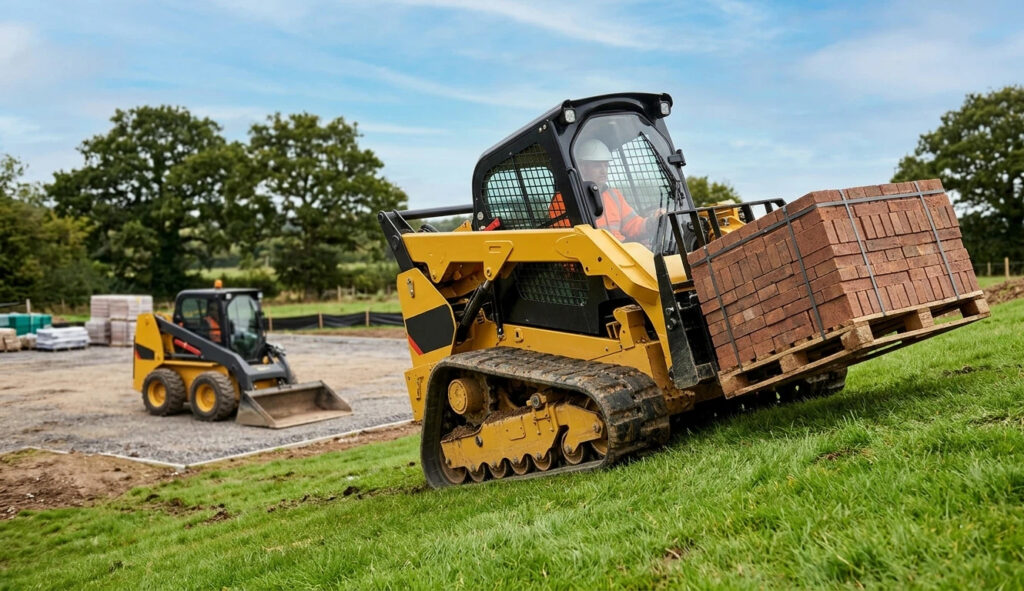
Stability is not just about comfort; it’s about safety. Because a CTL has a longer and heavier footprint, it generally has a higher “tipping load” and “rated operating capacity” (ROC) than a similarly sized wheeled unit. The tracks act as a counterweight and a stable platform, reducing the “rocking” motion when the bucket is fully loaded and raised.
If your primary task is lifting heavy stone, large boulders, or saturated bags of mulch, the mini skid steer vs CTL comparison leans toward the tracks. The added stability allows for more confident operation on slopes. A wheeled machine has a higher center of gravity relative to its contact points, making it more prone to tipping if it hits a hole while carrying a heavy load.
However, the “feel” of a wheeled machine is often preferred by veteran operators for its feedback. You can “feel” the traction through the tires in a way that is sometimes masked by the heavy undercarriage of a track loader. For precise digging in hard-packed clay, a wheeled unit can often apply more “down pressure” to the cutting edge of the bucket because the machine’s weight is concentrated on four points rather than spread out.
Comparison Matrix: Mini Skid Steer vs CTL
| Feature | Wheeled Mini Skid Steer | Compact Track Loader (CTL) |
| Ground Pressure | High (30-50 PSI) | Low (3.0-4.5 PSI) |
| Best Surface | Asphalt, Concrete, Hard Dirt | Mud, Sand, Wet Grass, Snow |
| Maintenance | Low (Tire-based) | High (Undercarriage-based) |
| Speed | Faster Travel Speed | Slower Travel Speed |
| Grading | Tends to follow ground contours | Excellent “Bridge” effect for level finish |
| Turn Type | Agile, high friction on hard surfaces | Gentle on soft soil, rough on hard surfaces |
Final Decision
Ultimately, the mini skid steer vs CTL debate isn’t solved in a showroom—it’s solved on the dirt. The “right” machine is the one that minimizes your environmental impact while maximizing your uptime.
If your business model is built on speed and hard-surface versatility, the wheeled unit is your workhorse. If your reputation is built on surgical precision in delicate environments and the ability to work when the competition is “rained out,” the CTL is your competitive advantage. Before you sign the lease, step out onto your next three job sites and look down. The soil is already telling you which machine to buy.
FAQ
Can I put tracks on my wheeled mini skid steer?
Yes, there are “Over-the-Tire” (OTT) track systems available. These provide a middle ground in the mini skid steer vs CTL debate, offering improved flotation when needed, though they aren’t as effective as a dedicated CTL undercarriage.
Which machine is better for snow removal?
It depends on the surface. For clearing large, paved parking lots, a wheeled unit with specialized snow tires is often faster and more efficient. For clearing deep snow off-road or on gravel, the CTL provides superior pushing power and traction.
Is the resale value higher for tracks or wheels?
Generally, a used CTL commands a higher price tag due to the initial cost, but the condition of the undercarriage is the “deal-breaker.” A wheeled machine with high hours is often easier to sell to a budget-conscious buyer because the refurbishment cost (new tires) is so low.
How do I decide for a tracked vs wheeled mini skid steer for landscaping projects?
Assess your most common job site. If you work in a region with high rainfall and heavy clay, go with tracks. If you are in a dry climate doing mostly hardscape installs (patios, driveways), wheels will save you thousands in maintenance.