
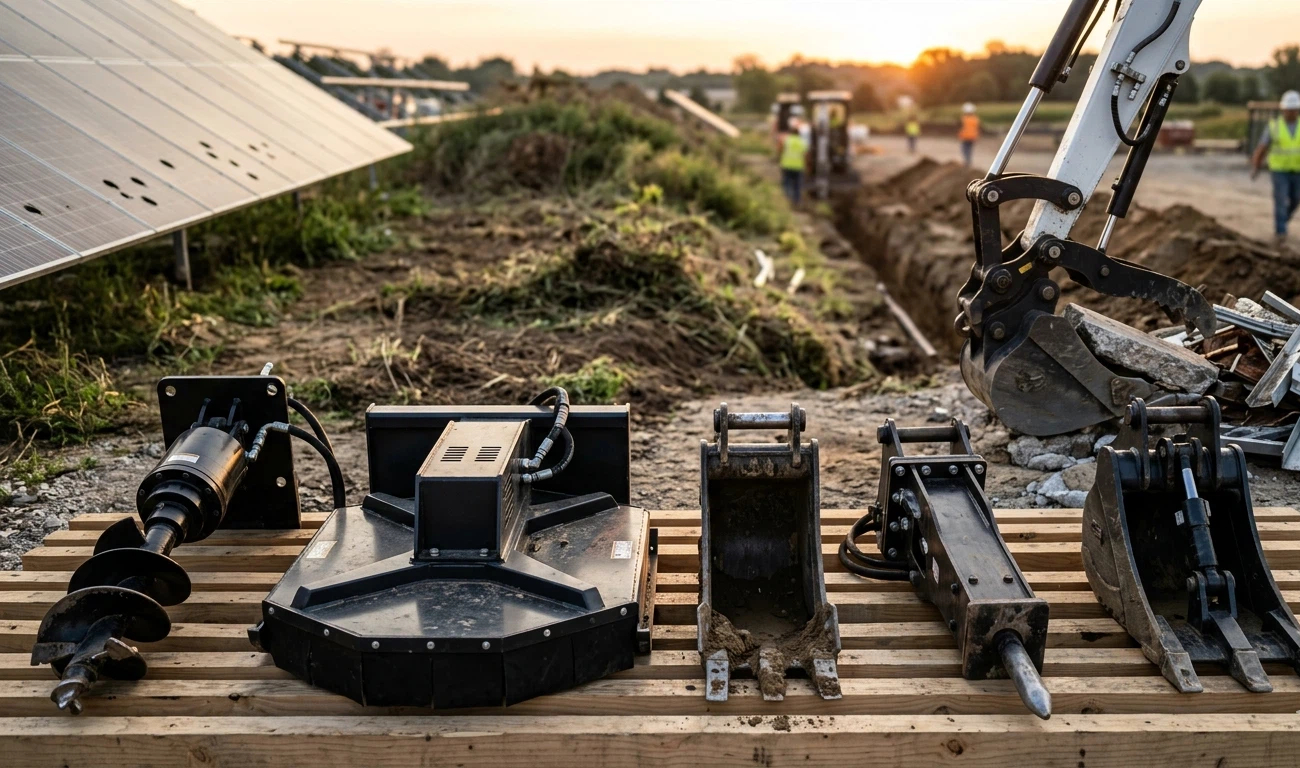
For a small construction or landscaping business, a compact excavator is a versatile power unit, but the true revenue isn’t generated by the machine itself—it’s generated by what you put on the end of the arm. In 2026, the competitive edge for contractors lies in specialization. By selecting the right mini excavator attachments, you can pivot from low-margin general labor to high-ticket, specialized contracts.
If you are currently researching the most profitable mini excavator attachments for contractors, you likely already know that labor is your biggest expense. The goal of this guide is to identify the tools that reduce man-hours while increasing your billable project rate.
Table of Contents
The Economics of High-ROI Mini Excavator Attachments
In the heavy equipment industry, we distinguish between “utility tools” and “profit centers.” A standard digging bucket is a utility tool—everyone has one, and the market rate for its use is capped. However, specialized mini excavator attachments allow you to bid on “results-based” contracts rather than “hourly-rate” jobs.
According to the Association of Equipment Manufacturers (AEM), the demand for compact attachment versatility is at an all-time high as urban construction sites become more cramped.
The Auger Attachment: Ground-Breaking Efficiency
The auger attachment is perhaps the most reliable secondary revenue stream for a small fleet. Whether you are installing residential fencing, planting commercial-grade trees, or setting footings for the booming solar farm market, an auger replaces a three-man crew with a single operator.
The profitability of an auger attachment comes from its precision. Unlike manual digging, which creates massive amounts of “spoils” (displaced dirt), a high-torque auger creates a clean, vertical hole that requires minimal backfill. For contractors, this means less time cleaning up and more time drilling. When selecting one, ensure the hydraulic drive matches your machine’s GPM (Gallons Per Minute) to prevent stalling in heavy clay or rocky soil.

The Brush Cutter: Dominating Vegetation Management
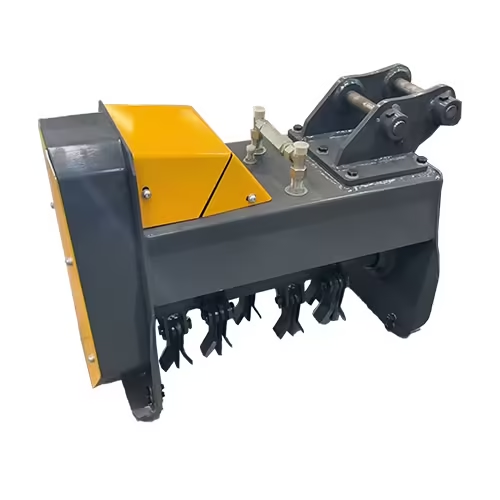
Land clearing is a high-risk, high-reward sector that has seen a surge in demand due to wildfire prevention mandates. A brush cutter mounted on a mini excavator can reach steep embankments, ditches, and overgrown fence lines that a skid steer or tractor simply cannot access.
This is one of the mini excavator attachments that allows you to charge “specialty equipment” rates. While a standard mowing service might charge $100 per hour, a specialized land-clearing service using a flail or rotary cutter can often command $200 to $300 per hour. The ROI is accelerated because you can clear an acre of dense thicket in a fraction of the time it would take a manual crew with chainsaws.
The Trenching Bucket: Precision in the “Last Mile” Boom
With the global push for high-speed fiber optics and upgraded underground utilities, the humble trenching bucket has become an essential profit center. While a standard bucket is 18-24 inches wide, a dedicated trenching bucket is usually 6-12 inches wide, designed specifically to minimize surface disruption.
Why is this one of the most profitable mini excavator attachments for contractors? Because it saves on restoration costs. In a suburban setting, a wider trench means more asphalt or sod to replace. A narrow, deep trenching bucket allows for “surgical” utility installation, making you the preferred subcontractor for utility companies who want to avoid high damage claims and expensive road repairs.

Comparative ROI Analysis for Mini Excavator Attachments
To help you prioritize your next capital investment, the table below compares the typical performance and return on investment for the top-rated tools in the 2026 market.
| Attachment Type | Est. Purchase Price (USD) | Primary High-Profit Application | Typical ROI Period (Months) |
| Auger Attachment | $1,800 – $4,200 | Fencing, Solar, Decking | 3 – 6 Months |
| Brush Cutter | $4,500 – $9,500 | Land Clearing, Fire Prevention | 8 – 12 Months |
| Trenching Bucket | $450 – $1,100 | Fiber Optics, Irrigation | 1 – 3 Months |
| Hydraulic Breaker | $3,500 – $7,000 | Concrete Demo, Renovation | 6 – 9 Months |
| Hydraulic Thumb | $1,500 – $3,000 | Material Handling, Scrap | Immediate (Efficiency) |
Hydraulic Breaker: Breaking Into Demolition Contracts
Demolition work is notoriously hard on equipment, but the profit margins are significantly higher than general earthmoving. Modern nitrogen-charged breakers have transformed these mini excavator attachments from “machine killers” into refined precision tools.
A small contractor with a breaker can bid on pool removals, driveway replacements, and interior commercial demolition. Because of the noise and vibration regulations in urban areas, being able to provide a “quiet-build” breaker solution (common in newer models) can help you win municipal contracts that older, louder equipment cannot qualify for.

The Hydraulic Thumb: The Efficiency Multiplier
While it isn’t always categorized as a standalone “tool,” a hydraulic thumb is the most critical addition you can make to your machine. It effectively turns your excavator into a crane and a sorter. If you are involved in site cleanup or stone masonry, the thumb increases your speed by over 50%.
When using mini excavator attachments like the thumb, the profitability is found in “man-power reduction.” You no longer need a ground worker to hook up chains or manually move debris. One operator can sort scrap, move boulders, and load trucks with surgical precision.

Technical Standards and Maintenance
Selecting the most profitable mini excavator attachments for contractors requires more than just looking at the price tag. You must ensure compatibility with international standards. For example, the ISO 20474-5 safety standard mandates specific load-holding requirements for attachments like thumbs and couplers.
Furthermore, the material matters. High-quality mini excavator attachments should be fabricated from high-strength steels (like AR400 or A36 equivalent) to withstand the high breakout forces of modern machines. Without durable materials, your “profit center” quickly becomes a “maintenance pit.”
How to Calculate Your Business ROI
To determine if a new attachment is worth the investment, use this simple formula:
1.Total Cost: Purchase price + Annual maintenance.
2.Projected Revenue: Additional hourly rate x estimated billable hours per year.
3.Labor Savings: Man-hours saved x average hourly wage.
If the sum of your projected revenue and labor savings exceeds the total cost within the first 12 months, the tool is a high-priority purchase.
Conclusion
The transition from a “guy with an excavator” to a “specialized contractor” happens the moment you invest in the right mini excavator attachments. By focusing on high-ROI tools like the auger attachment, brush cutter, and trenching bucket, you ensure that your business stays profitable even when the general construction market fluctuates.
FAQ
Can I use the same attachments on different machine brands?
Usually, yes. Most 2026 models use a universal quick-coupler system, though you must verify the pin diameter and hydraulic flow (GPM) compatibility.
Which attachment has the highest resale value?
Hydraulic breakers and augers tend to hold their value well, provided they have been serviced regularly.
Are used mini excavator attachments worth buying?
Only if you can verify the hydraulic seals and the integrity of the steel. For high-wear items like buckets, buying new is often more cost-effective over a 3-year period.