

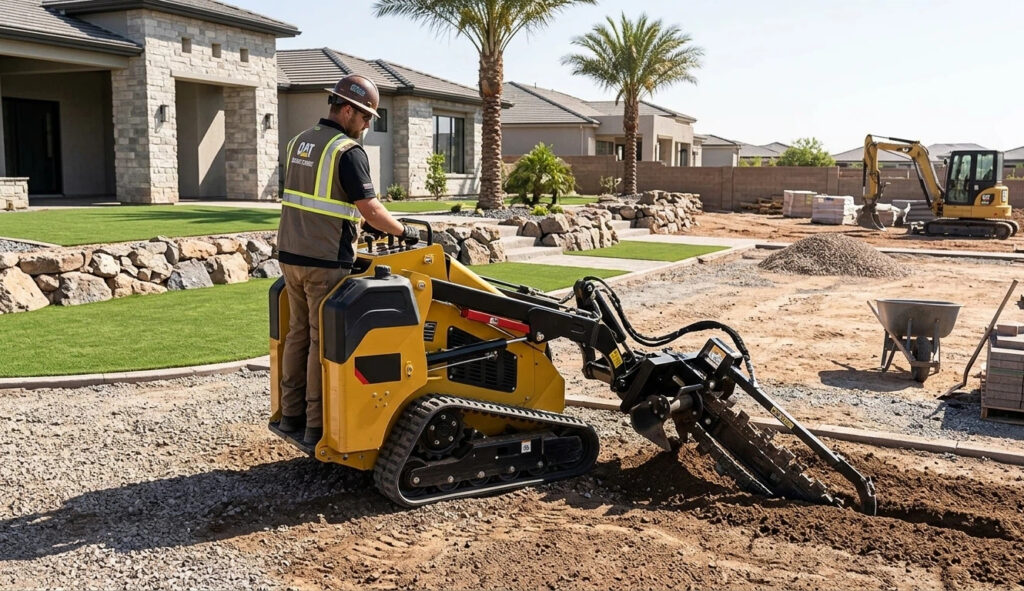
In the world of compact construction equipment, horsepower is no longer the only metric that matters. For contractors working in residential landscaping, urban utility repair, or tight demolition sites, the real bottleneck isn’t the machine’s raw strength—it’s the operator’s ability to see, move, and react. This is precisely why the stand on mini skid steer has shifted from a niche rental tool to a primary fleet asset for serious professionals.
The transition from traditional “in-the-cab” seated loaders to platform-based designs represents a fundamental shift in jobsite philosophy. It’s about removing the barrier between the operator and the work environment. Whether you are navigating a zero-lot-line backyard or grading a complex hardscape, the way you interface with your machine dictates your daily profit margins.
Table of Contents
tand-on Loaders vs. Seated Models
The most immediate technical upgrade when switching to a stand on mini skid steer is the perspective. Traditional seated skid steers, while powerful, suffer from inherent “cage blindness.” The ROPS (Roll-Over Protective Structure) pillars, the high engine cowling, and the side mesh screens create significant blind spots, particularly at the rear and the attachment corners.
When analyzing the operator visibility of stand-on loaders vs seated configurations, the stand-on platform wins by a landslide. Standing at the rear of the machine provides a natural, elevated vantage point. You aren’t just looking through a window; you are part of the environment. This creates 360-degree jobsite awareness, allowing you to monitor ground workers, nearby utilities, and the exact edge of your bucket or pallet forks without straining your neck or relying on faulty backup cameras.
According to safety guidelines from the American Society of Agricultural and Biological Engineers (ASABE), visibility is a primary factor in preventing “run-over” or “pinned-between” accidents on small-scale sites. Read more on their safety standards here: ASABE Standards.
Ride-on Skid Steer Benefits
For a busy contractor, time is measured in “cycles.” A cycle might be moving a pile of mulch, backfilling a trench, or loading a trailer. One of the greatest ride-on skid steer benefits is the radical reduction in transition time.
In a seated machine, getting in and out involves lifting a safety bar, opening a heavy door, and maneuvering out of a cramped seat. This “entry/exit tax” adds up when an operator needs to stop to move a stray irrigation pipe or talk to a client. The mounting and dismounting convenience of a stand-on platform means the operator can step off, clear an obstacle, and step back on in seconds.
This makes it the best mini skid steer for frequent on-off tasks. When the operator isn’t “trapped” in a cab, they are more likely to perform manual ground checks, leading to higher quality work and fewer mid-project errors.
Stand-on vs. Walk-Behind Skid Steer
It is a common mistake to lump stand-on units in with walk-behind loaders. While they share a similar footprint, the performance gap is vast.
Speed and Reach
A walk-behind unit requires the operator to physically keep pace with the machine. This limits ground speed to a human walking pace (typically 3 mph). A stand on mini skid steer is engineered for travel speeds of 5 to 6 mph. On a large property, that extra 2 mph translates to hundreds of extra square feet covered per hour.
Zero-Turn Maneuverability
Modern stand-on units utilize sophisticated hydraulic pilots that offer zero-turn maneuverability. Because the operator’s weight is positioned over the drive tracks, the machine has a more balanced center of gravity compared to a walk-behind, where the operator is an external force trailing behind. This balance allows for tighter turns in “gate-access only” backyards without tearing up the turf.
Why a Stand On Mini Skid Steer is the Best Choice for Fast-Paced Jobsites
Construction and landscaping are physically demanding. If your crew is exhausted by noon, your afternoon production drops. This is where the ergonomic stand-on platform becomes a financial asset.
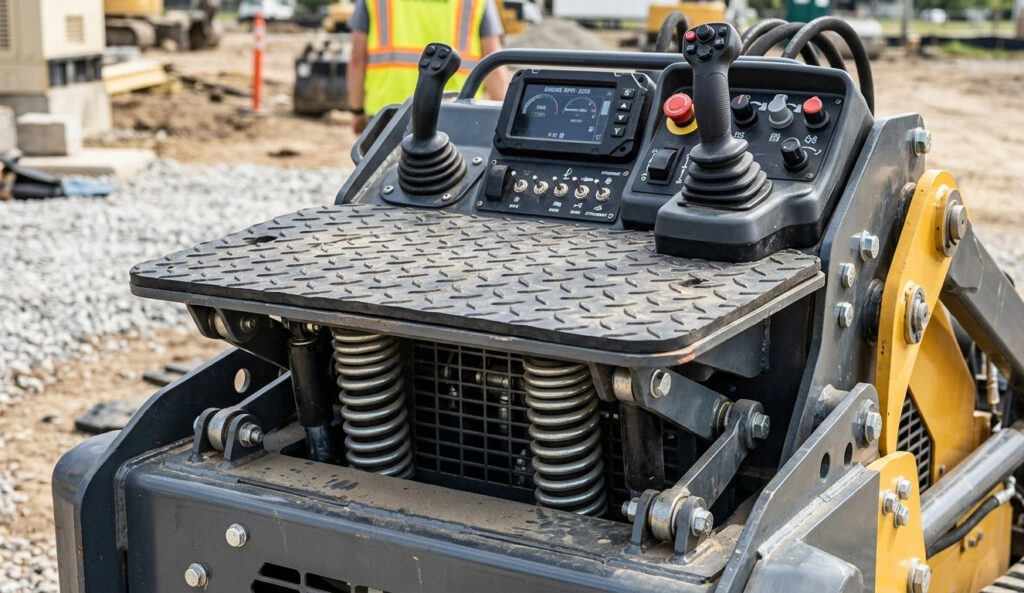
We often hear the question: “Isn’t standing all day more tiring than sitting?” The industry data suggests otherwise. Sitting in a vibrating cab on a rigid seat transfers every jolt of the terrain directly into the operator’s spine. Conversely, standing allows the operator to use their legs as natural shock absorbers.
Furthermore, high-end manufacturers are now focusing on mini skid steer platform suspension vs rigid frames. A suspended platform isolates the operator from the machine’s vibration, significantly reducing operator fatigue in landscaping projects. When your operator feels better, they work faster and more safely.
Safety Infrastructure
Safety is not just a checkbox; it is a liability shield. The stand-on mini loader safety features for contractors go beyond simple lights and horns. One of the most underrated safety advantages is the “quick-exit” capability.
If a machine begins to tip on an unstable slope, a seated operator is strapped into the danger zone. An operator on a stand on mini skid steer can simply step off the back. This ability to instantly disengage from a tipping machine is a life-saving feature that seated cabs cannot replicate.
ROI and Fleet Versatility
Investing in a stand on mini skid steer is an investment in versatility. Because these machines are narrower than their seated counterparts, they can access areas that previously required manual labor with shovels and wheelbarrows.
The hydraulic output of a modern stand on mini skid steer is now comparable to larger units, allowing them to run high-flow attachments like stump grinders, vibratory plows, and soil conditioners. You are getting the power of a full-sized loader in a package that fits through a 36-inch garden gate.
conclusion
The decision to add a stand on mini skid steer to your fleet isn’t just about following a trend—it’s about responding to the realities of modern contracting. Between the superior operator visibility of stand-on loaders vs seated machines and the sheer mounting and dismounting convenience, the stand-on design is built for the way work actually happens on the ground.
By focusing on operator comfort and 360-degree jobsite awareness, you aren’t just buying a machine; you are buying a more efficient, safer, and more profitable jobsite. If you want to maximize your crew’s potential and tackle the tightest jobs with confidence, the stand on mini skid steer is the tool that will get you there.
FAQ
Is a stand-on loader stable on slopes?
Yes, but technique matters. Because the operator’s weight is on the rear, these machines often have a lower center of gravity than seated models. Always keep the heavy end of the stand on mini skid steer pointed uphill.
Can a stand-on unit lift as much as a seated skid steer?
Generally, seated units have higher rated operating capacities (ROC), but many stand on mini skid steer models now reach 1,000+ lbs ROC, which is sufficient for most residential landscaping tasks.
How do they handle soft turf?
Most stand-on units use wide tracks rather than tires. This distributes the weight over a larger surface area, resulting in lower ground pressure and less damage to established lawns.