
Table of Contents
Buying a used excavator demands more than a quick glance at the hour meter. A professional used excavator evaluation strips away the noise and answers the key question purchasers actually care about: how much productive life remains and what will it cost to keep the machine in service. This guide gives a practical, inspection-driven framework—engine hours vs pump hours, wear-pattern forensics, oil analysis, and a simple scoring model—so buyers, fleet managers, and dealers can make data-backed purchase decisions.
Key takeaway: treat the hour reading as one input among many; a structured used excavator evaluation will reveal how hard a machine worked and what its remaining economic life really looks like.
Why hours alone can be misleading
Hour meters only measure elapsed run time; they do not record load, duty cycle, or idle percentages. Machines that spent most of their hours idling or doing light landscaping will often be in much better condition than machines that worked fewer hours in heavy-duty mining or demolition. Practical field experience and condition-based testing outperform raw hours when estimating longevity.
Understanding the different hour counts
- Engine hours — the total time the engine has been running. This is what most hour meters show and what many buyers reference first.
- Hydraulic (pump) hours / work hours — records how long the hydraulic systems were under load (some modern telematics differentiate these). Pump-intensive duty accelerates wear on hydraulic components, final drives, and attachments.
- Idle time — extended idling inflates engine hours without proportional mechanical work and can mask true working stress.
A complete used excavator evaluation always asks where the hours came from and whether telematics or job-site logs can confirm the duty cycle.
What wear patterns reveal about previous working conditions
Experienced inspectors read the machine like a résumé—typical signs and what they imply:
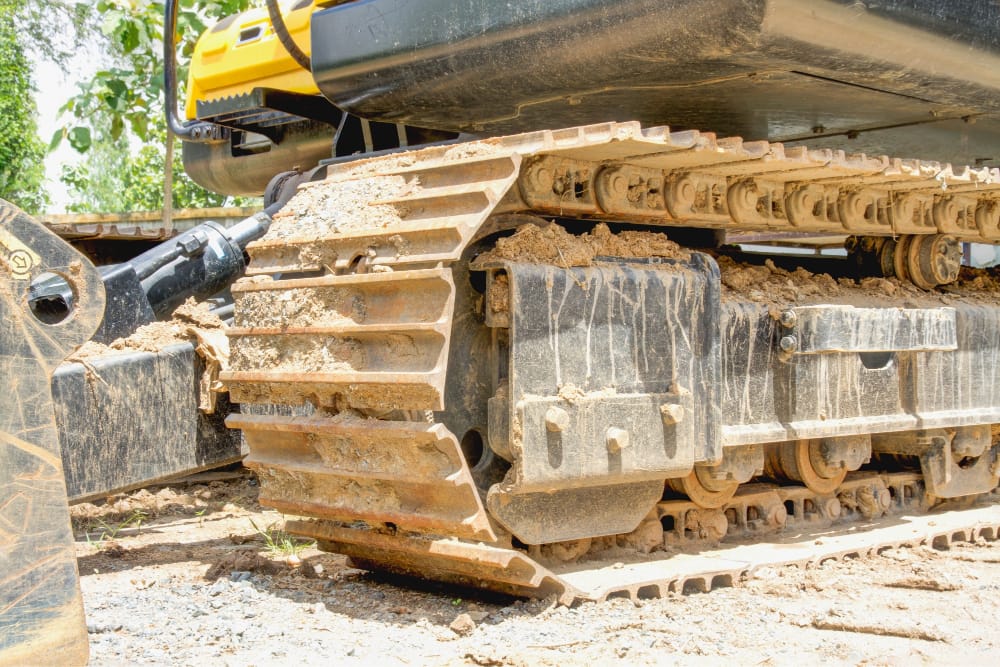
- Undercarriage wear: aggressive, uneven wear, gouged shoes, and rapid sprocket tooth loss frequently indicate heavy rock, quarry, or mining work. Proper undercarriage condition is one of the single most predictive elements for remaining life and rebuild cost. Manufacturer guidance emphasizes how operating surface hardness and operating practices affect undercarriage life.
- Bucket and teeth: flattened or heavily chipped teeth, welded repairs, or distorted bucket lips point to abrasive rock work or overloading.
- Pins and bushings: excessive play or uneven pin wear suggests poor lubrication practices or cyclical heavy loads.
- Frame and weld repairs: multiple or recent structural welds often signal past impacts or over-stress.
- Hydraulic leaks and hose condition: repeated leaks, swollen hoses, or metallurgical deposits in return lines can indicate long-term hydraulic stress or contamination.
A hands-on used excavator evaluation converts these observations into risk categories for major systems (undercarriage, hydraulics, powertrain, structure).
Practical tests and measurements to include
A professional used excavator evaluation should combine visual inspection with simple measurable diagnostics:
1.Operational test — run the machine through its full range: boom, stick, swing, travel under load, and observe response, lag, noise, and vibration.
2.Oil and fluid sampling — engine oil, hydraulic oil, and coolant analysis identify wear metals, water ingress, and contamination; oil analysis is a high-value diagnostic.
3.Compression and leak-down checks (where practical) — indicate engine health beyond basic visual signs.
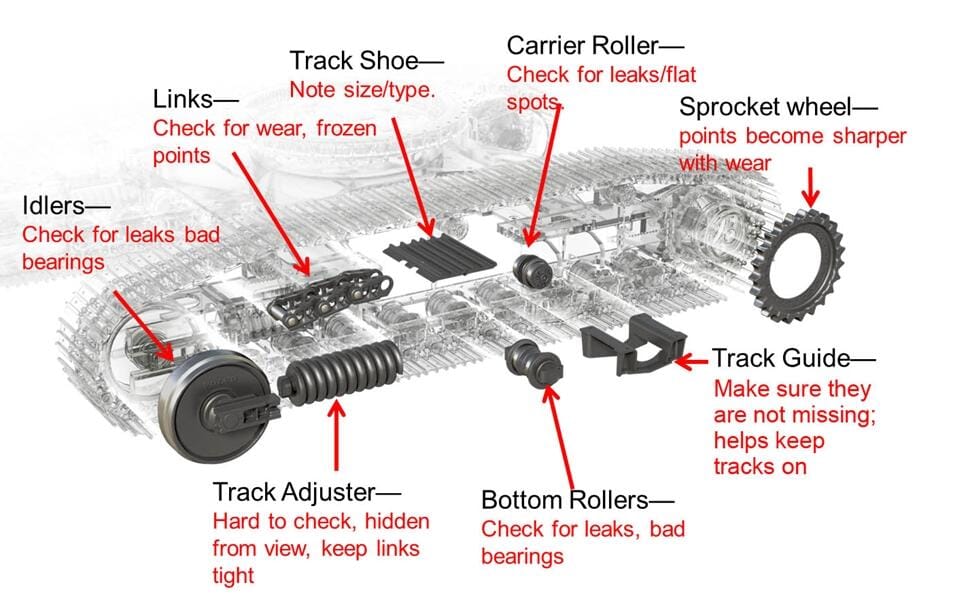
4.Undercarriage measurement — measure shoe wear, sprocket tooth profile, and track sag to estimate remaining undercarriage life. Manufacturer guides are clear that undercarriage condition varies with ground material and operation.
5.Hydraulic system checks — look for pressure irregularities, pump noise, or sluggish cylinder response that point to pump wear or contamination. A focused used excavator evaluation will correlate pump condition to expected remaining service life of hydraulic components.
A simple scoring model to estimate remaining economic life
Convert inspection findings into a repeatable score that supports pricing and financing decisions. Example weighted model (customize to fleet priorities):
- Total hours (or verified work hours) — 25%
- Working conditions / wear pattern — 30%
- Maintenance and repair history — 25%
- Structural condition (frame, welds, pins) — 10%
- Brand & model reliability / parts availability — 10%
Translate the aggregated score into conservative remaining service life bands (example):
- 85–100: High remaining life (buy with confidence)
- 65–84: Moderate remaining life (factor maintenance into offer)
- 40–64: Limited remaining life (budget for major components)
- <40: High-risk — avoid or price for full rebuild
Use this quantitative used excavator evaluation to produce a comparable score across machines and fleet acquisitions.
Case study: same hours, different life
Two 20-ton excavators, both showing 5,000 engine hours on the meter:
- Machine A: Evidence of heavy rock abrasion—deep undercarriage wear, worn bucket teeth, multiple welded repairs. Oil analysis shows elevated iron and silicon levels consistent with abrasive contamination. A conservative used excavator evaluation scores this unit in the 45–55 range; remaining life is likely limited without immediate undercarriage and hydraulic attention.
- Machine B: Same hours, but municipal/light civil work documented; undercarriage shows even, moderate wear; complete maintenance logs with timely oil changes; oil samples within acceptable limits. The used excavator evaluation yields a score in the 78–88 range and projects 30–40% more remaining productive life than Machine A.
Conclusion from the example: identical meter readings can hide dramatically different economics. Proper used excavator evaluation converts those differences into dollars and risk.
What counts as “low hours” in the market
“Low hours” is relative to machine class and intended use. As a rough guideline for mid-size machines:“
- Mini / compact: under 3,000 hours often viewed as low.
- 20–30 ton class: under 5,000 hours commonly considered low or mid-life depending on use.
- Large, heavy-duty excavators: lifecycle expectations increase, and “low” may be under 8,000–12,000 hours in some contexts. These lifespan ranges are consistent with industry experience and lifecycle reports.
- Use these ranges only as baseline filters; follow-up with a full used excavator evaluation to confirm suitability.
Quick inspection checklist
A compact checklist for a site visit—use as the core of any used excavator evaluation:
- Verify hour meter authenticity and telematics logs.
- Review maintenance and repair history (work orders).
- Inspect undercarriage: shoes, sprockets, rollers, idlers, track tension.
- Examine bucket, teeth, pins, and linkages for wear or repairs.
- Check for structural welds, cracks, and alignment.
- Perform engine start and operational checks; listen for abnormal sounds.
- Sample engine oil and hydraulic oil for lab or portable analysis.
- Inspect cooling system, hoses, and radiator condition.
- Check attachments and coupler wear.
Final thoughts — turn inspection into confident purchasing
A repeatable, measurement-driven used excavator evaluation removes guesswork. The hour meter is useful, but it is not destiny—working conditions, maintenance rigor, and component-level diagnostics determine the true remaining service life. Buyers who apply a structured inspection process and back it with oil analysis, undercarriage measurement, and operational testing can make offers that reflect real value rather than meter-driven emotion.
FAQ
What is considered low hours for a used excavator?
For compact excavators, under 3,000 hours is often considered low. For mid-size machines (20–30 tons), under 5,000 hours may be viewed as low. However, a proper used excavator evaluation should also consider wear, maintenance history, and working conditions.
Can low hours guarantee a good used excavator?
No. Low hours alone do not guarantee a machine is in good condition. A complete used excavator evaluation should also examine structural wear, hydraulic performance, and maintenance records.
How do professionals perform a used excavator evaluation?
A professional used excavator evaluation usually includes visual inspection, operational testing, and checking maintenance history to estimate the machine’s condition and remaining service life.
Why is working environment important when evaluating a used excavator?
Different working environments create different wear patterns. During a used excavator evaluation, identifying whether the machine worked in mining, demolition, or light construction helps estimate its remaining lifespan.

