In modern urban construction and residential landscaping, the primary challenge is rarely the volume of earth to be moved, but rather the accessibility of the site itself. As plots become smaller and architectural designs more complex, the role of a high-performance mini digger has transitioned from a simple convenience to an engineering necessity. Successfully navigating these constraints requires more than just a compact machine; it requires a deep understanding of hydraulic geometry and chassis mechanics.
Table of Contents
The Entry Problem: Solving the “Standard Door” Constraint
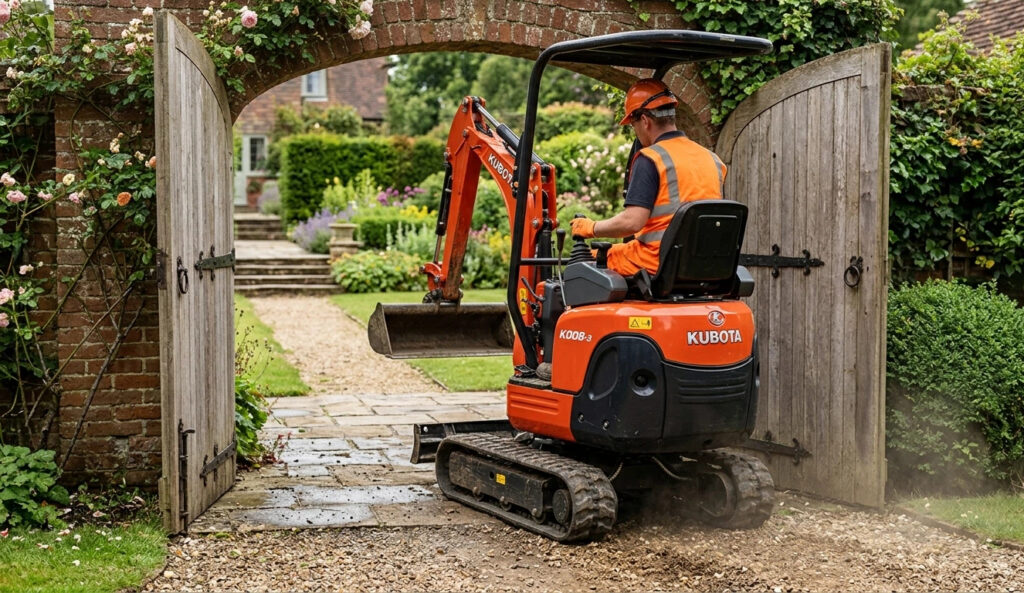
The most common pain point in residential renovation or indoor demolition is the physical entry point. Traditional plant machinery often fails to reach backyards or interior basements due to narrow alleys or standard doorways. To address this, selecting a mini digger that fits through a standard door—typically requiring a width of less than 800mm—is the first critical decision.
This is where an expanding undercarriage becomes indispensable. For transit, the tracks can be retracted to a width of roughly 700mm to 750mm. Once the machine has passed through the narrowest point, the operator must expand the tracks to their full width (often up to 1000mm) to restore lateral stability. Operating a mini digger on a retracted chassis during actual excavation is a significant safety hazard that can lead to tipping, especially when handling heavy loads at full reach.
Lateral Constraints: Zero Tail Swing and Boom Swing Functionality
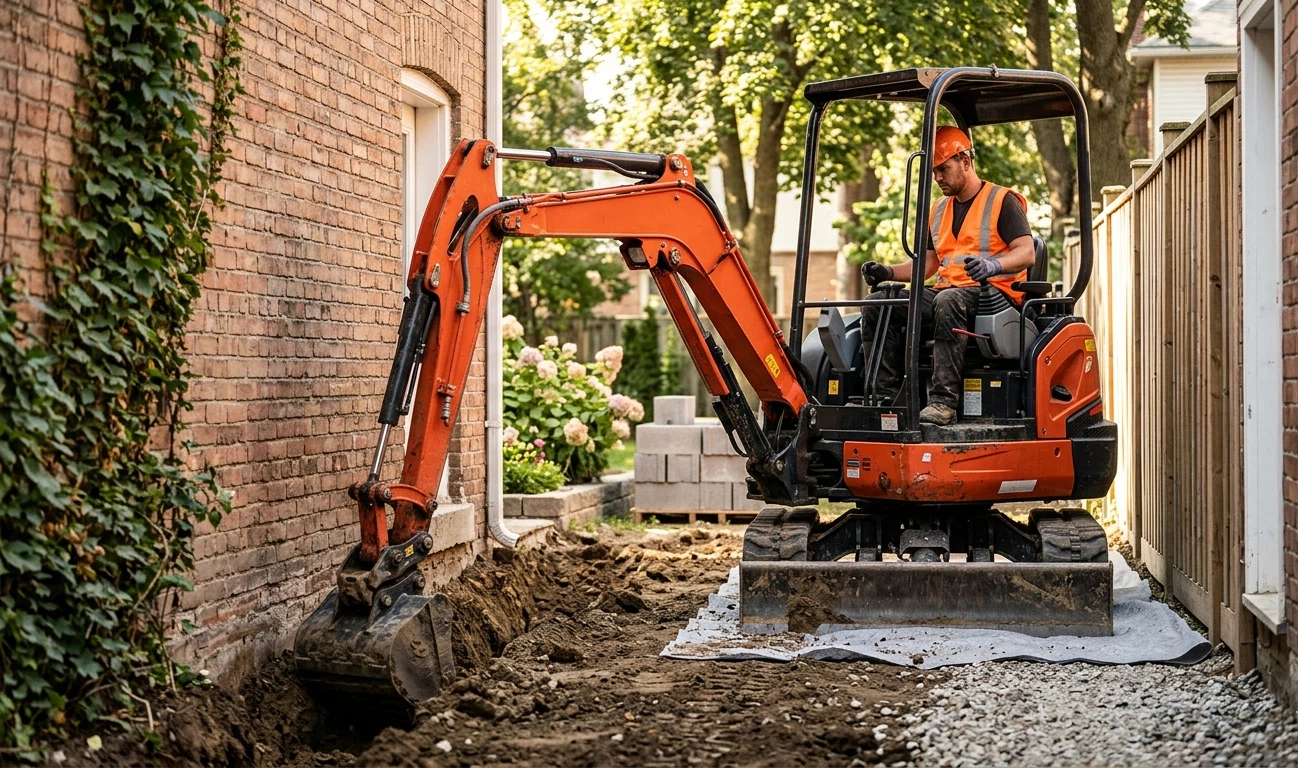
Once on-site, the next hurdle is the proximity of existing structures. When excavating near house walls or fences, a conventional machine’s rear counterweight often risks colliding with the masonry during a 360-degree slew. The engineering solution is Zero Tail Swing (ZTS) technology. In a ZTS mini digger, the upper body rotates entirely within the width of the tracks, allowing the operator to focus on the trench without fear of rear-end impact.
However, ZTS alone does not solve the problem of digging parallel to a wall. For this, a machine must be equipped with a boom swing function. Unlike a standard excavator where the boom is fixed to the center of the frame, a swing boom allows the primary arm to pivot independently of the house. This enables the mini digger to dig a trench directly alongside a foundation while the chassis remains parallel to the structure, a vital feature for perimeter drainage and utility installations.
Force vs. Size: Optimizing Hydraulic Breakout Force
A frequent complaint with smaller units is their tendency to “jump” or lose traction when encountering heavy clay or rocky soil. This is usually a symptom of a mismatch between the machine’s weight and its hydraulic breakout force. When excavating foundations in tight spaces, the hydraulic system must provide enough pressure to the bucket cylinder to penetrate the ground without lifting the entire machine off its stabilizers.
| Machine Class | Avg. Width (Retracted) | Typical Breakout Force | Ideal Application |
| Micro (< 1 Ton) | 700mm – 750mm | 8kN – 10kN | Indoor demo, narrow gardens |
| Mini (1.5 – 2 Ton) | 980mm – 1300mm | 12kN – 16kN | Foundation trenching, utilities |
| Compact (3 – 5 Ton) | 1500mm – 1900mm | 25kN – 40kN | Roadwork, large landscaping |
Surface Protection: Rubber Tracks vs Steel Tracks
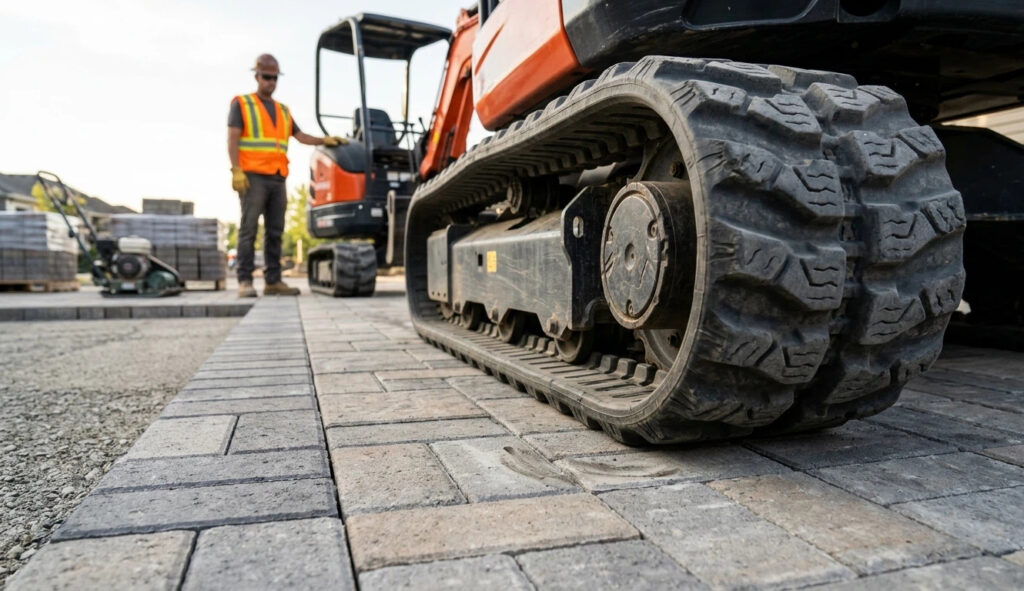
In the context of the best mini digger for narrow garden access, the impact on the existing environment is as important as the excavation itself. For finished landscapes, driveways, or indoor floors, the choice of rubber tracks vs steel tracks is clear. Rubber tracks provide the necessary flotation to prevent ground pressure from damaging turf or cracking pavers. Furthermore, rubber tracks reduce vibration, which is a critical consideration when operating a mini digger in close proximity to sensitive residential foundations or over underground cellar voids.
Precision Trenching and Underground Utility Safety
Precision is the hallmark of professional excavation. When performing mini digger for narrow garden access projects, the risk of striking buried utilities—gas, water, or fiber optics—is significantly higher due to the density of urban services.
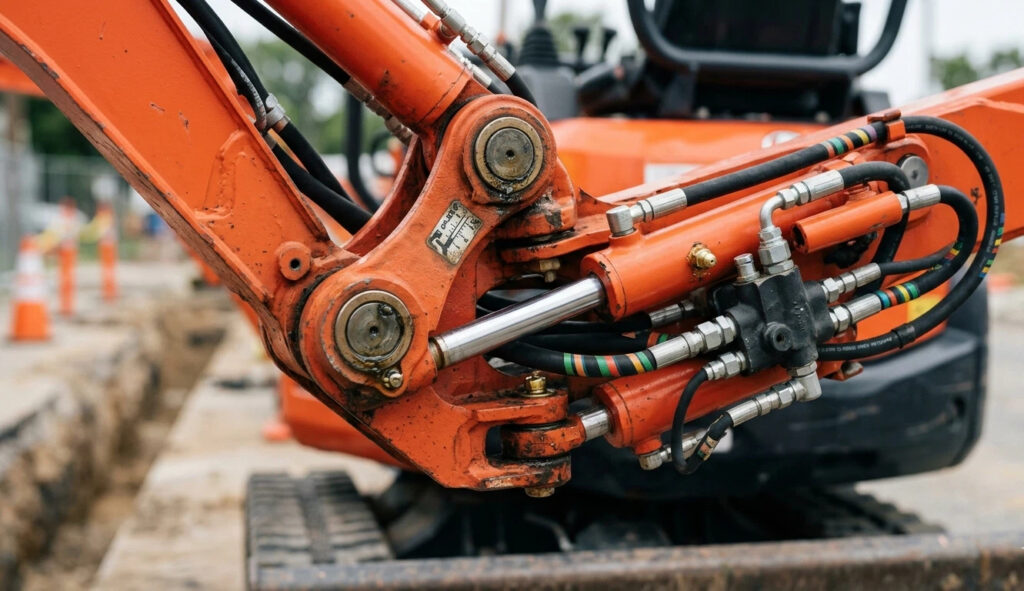
Operators should utilize machines with pilot-operated joystick controls rather than mechanical levers. Pilot controls offer a much higher degree of modulation, allowing for the “surgical” removal of soil around known cable runs. According to the HSE Construction Safety Guidelines, safe excavation always begins with manual trial holes, but a high-precision mini digger ensures that the subsequent mechanical clearing is controlled and safe.
Conclusion
The evolution of the mini digger has moved beyond simple downsizing. Today’s machines are sophisticated engineering platforms designed to solve specific site-access dilemmas. By prioritizing features like an expanding undercarriage for access and Zero Tail Swing for operational safety, contractors can undertake complex projects in areas previously thought to be inaccessible to mechanical plant.
FAQ
Can a mini digger really fit through a house?
Yes, machines in the 0.8-ton to 1-ton class are specifically designed with a width of 700mm-750mm to pass through internal doorways for basement or courtyard work.
What is the main advantage of boom swing over ZTS?
ZTS prevents the back of the machine from hitting obstacles when turning. Boom swing allows you to dig a trench offset from the center of the machine, which is essential for digging right next to a wall.
Are rubber tracks less durable than steel?
In harsh, rocky terrain, steel is more durable. However, for 90% of mini digger applications in urban environments, rubber tracks are the industry standard due to surface protection and operator comfort.
How do I know if my site is too narrow for a 1.5-ton machine?
Always measure the narrowest point of access. If the gap is less than 1 meter, you will likely need a micro digger with an expanding undercarriage.