Most contractors focus heavily on the initial purchase price, but the real story of profitability is written in the daily ledger. Whether you are running a single unit or managing a multi-state rental fleet, the ability to accurately forecast Mini Skid Steer Operating Costs is what separates high-margin operations from those struggling to stay afloat.
In the world of compact equipment, these machines are often pushed to their limits in tight spaces and harsh environments. This intensity means that “hidden” expenses can quickly erode your project’s bottom line if not managed with surgical precision.
Table of Contents
The Breakdown: Fixed vs. Variable Costs
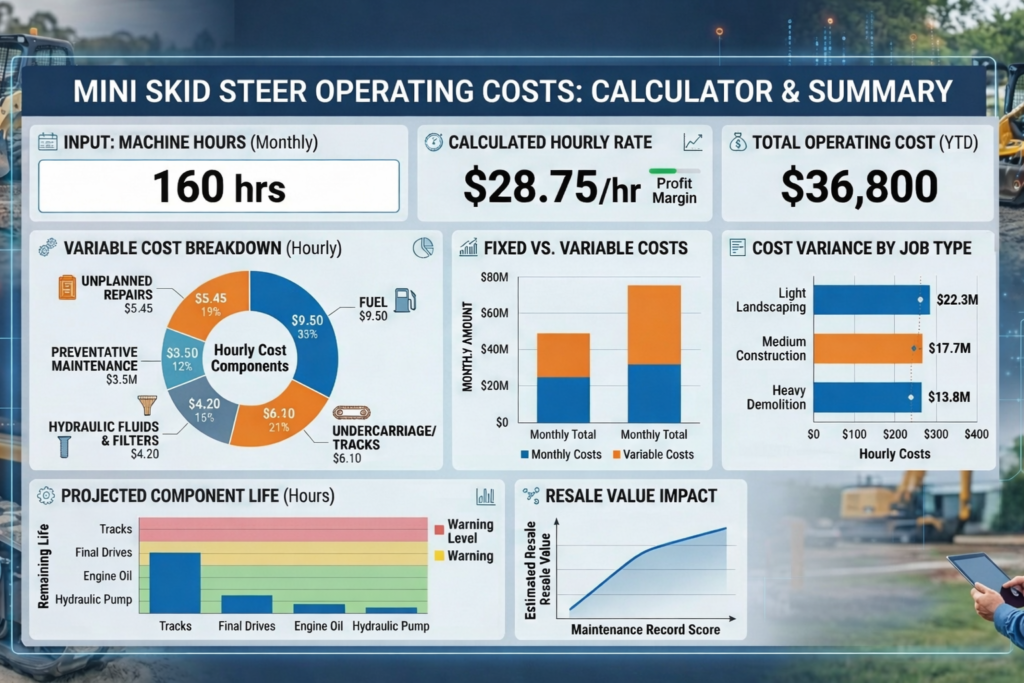
To get a clear picture of your Mini Skid Steer Operating Costs, you must categorize expenses into two buckets: fixed (ownership) and variable (operating).
Fixed costs include insurance, financing interest, and storage. These remain constant regardless of whether the machine is moving dirt or sitting in the yard. However, the variable side—fuel, lubricants, and wear items—is where the volatility lies. By calculating these on an hourly basis, you can establish a “break-even” rate that informs your bidding strategy.
Fuel Efficiency and Fluid Consumption
Fuel is usually the largest recurring expense. Modern Tier 4 Final engines have improved fuel economy, but they also introduced new variables like DEF (Diesel Exhaust Fluid) for larger units and more sensitive fuel filtration requirements.
When evaluating Mini Skid Steer Operating Costs, don’t just look at the gallons per hour. Consider the idle time. High-idle durations contribute to “wet stacking” and unnecessary fuel burn, driving up the hourly rate without generating revenue. Optimizing the Fuel Efficiency and Fluid Consumption of your fleet through telematics can save thousands over the machine’s lifecycle.
The “Silent Killer”: Undercarriage and Tire Wear
The ground-engaging components are where most owners “bleed” cash without realizing it. For tracked units, the undercarriage is the most expensive wear item. Factors like track tension and the abrasive nature of the job site (e.g., jagged rock vs. soft soil) have a massive impact of undercarriage wear on operating expenses.
| Component Type | Estimated Life (Hours) | Replacement Cost (Est.) | Hourly Cost Contribution |
| Rubber Tracks | 800 – 1,200 | $1,500 – $2,500 | $1.50 – $2.50 |
| Pneumatic Tires | 500 – 800 | $800 – $1,200 | $1.20 – $1.80 |
| Drive Sprockets | 2,000+ | $600 – $900 | $0.30 – $0.45 |
Neglecting track tensioning doesn’t just damage the tracks; it places undue stress on the final drives, which can turn a routine maintenance item into a catastrophic repair that spikes your Mini Skid Steer Operating Costs.
Depreciation and Resale Value Strategy
Depreciation is often the most overlooked part of Mini Skid Steer Operating Costs. It is a “non-cash” expense that hits you at the end of the machine’s life. A machine that loses 50% of its value in three years is significantly more expensive to own than one that retains 70%.
To mitigate this, savvy owners focus on Depreciation and Resale Value by keeping meticulous service logs. A machine with a documented history of oil sampling and 250-hour interval services commands a premium on the secondary market. Essentially, spending slightly more on preventative care lowers the long-term Mini Skid Steer Operating Costs by recouping more capital during the trade-in.
Labor and Training: The Human Factor
An inexperienced operator can increase your Mini Skid Steer Operating Costs by up to 25%. Aggressive counter-rotating on asphalt, “spinning” the tracks, or ignoring warning lights leads to premature wear. Investing in operator training is not just about safety; it is a direct strategy for reducing downtime through preventative inspections and better machine handling.
If an operator performs a 5-minute pre-start walk-around and catches a leaking hydraulic fitting early, they save the company the cost of a blown pump and 8 hours of lost productivity. This proactive culture is essential for keeping Mini Skid Steer Operating Costs within budget.
The Impact of Duty Cycle on Hourly Rates
Not all hours are created equal. A machine used for light landscaping on mulch has a different cost profile than one used for 10-hour shifts in a concrete demolition environment. When calculating your Mini Skid Steer Operating Costs, categorize your projects into “Light,” “Medium,” and “Extreme” duty cycles. This allows for more accurate job costing and prevents you from under-bidding on high-wear projects.
Total Cost of Ownership (TCO) Comparison
When we look at the Total Cost of Ownership (TCO), we see that the hourly operating cost usually falls between $15 and $35 per hour (excluding the operator’s wage). By tracking every filter, every quart of oil, and every hour of downtime, you can identify exactly when a machine becomes too expensive to keep.
If your Mini Skid Steer Operating Costs begin to trend upward as the machine nears the 3,000-hour mark, it is likely time to cycle that unit out of the fleet before a major component failure occurs.
FAQ
How to calculate hourly rate for mini skid steers?
To find your hourly rate, add your monthly financing/insurance (Fixed) to your monthly fuel and maintenance spend (Variable), then divide by the total hours worked that month. Don’t forget to add a “reserve” for future track/tire replacement. This is the only way to truly monitor your Mini Skid Steer Operating Costs.
Does cold weather significantly increase Mini Skid Steer Operating Costs?
Yes. Cold starts increase engine wear, and hydraulic fluids require longer warm-up periods to reach optimal viscosity. In sub-zero environments, fuel additives and block heaters are necessary expenses that should be factored into your winter operating budget.
How can I lower my Mini Skid Steer Operating Costs without sacrificing performance?
Focus on reducing downtime through preventative inspections. Catching a loose bolt or a clogged radiator before it causes a shutdown is the single most effective way to keep your hourly costs low.
Why is oil analysis important for managing Mini Skid Steer Operating Costs?
Oil sampling provides a window into the internal health of the engine and hydraulics. By detecting trace metals early, you can schedule a repair during the off-season rather than dealing with an emergency breakdown in the middle of a high-stakes project.