If you want to operate mini excavator machinery safely, you must first understand that power requires respect. Mini excavators have revolutionized the modern job site, offering a blend of precision and power that larger machines simply cannot match in confined spaces. From residential landscaping to large-scale utility work, these compact powerhouses are the backbone of efficient earthmoving. However, their accessibility is a double-edged sword. Every year, thousands of rental units and fleet assets are damaged because operators fail to respect the learning curve.
If you are learning how to operate a mini excavator, your goal isn’t just to move dirt—it is to do so with the efficiency of a seasoned professional while protecting the machine’s longevity. Your first few hours in the cab will feel clunky, but by avoiding these five common pitfalls, you can bridge the gap between “rookie” and “reliable operator” much faster.
Table of Contents
1.Ignoring Gravity: Working on Slopes Without a Strategy
The most dangerous mistake a beginner can make is misunderstanding the machine’s center of gravity. A mini excavator feels stable on flat concrete, but that stability vanishes the moment you enter uneven terrain. One of the most vital beginner excavator tips involves the orientation of the “idlers” and the “sprockets.” Beginners often drive onto a slope with the heavy sprockets facing downhill. If the machine slips, the track can “throw,” or worse, the machine can tip.
When you operate mini excavator units on an incline, always keep the heavy end (the drive sprockets) uphill. This keeps the weight anchored. Furthermore, never swing the boom downhill while on a slope; the centrifugal force can easily exceed the machine’s tipping point. According to the Occupational Safety and Health Administration (OSHA) Excavation Standards, improper positioning on unstable ground is a leading cause of fatalities in trenching operations.
2.”Dry-Firing” the Hydraulics: The Jerky Control Trap
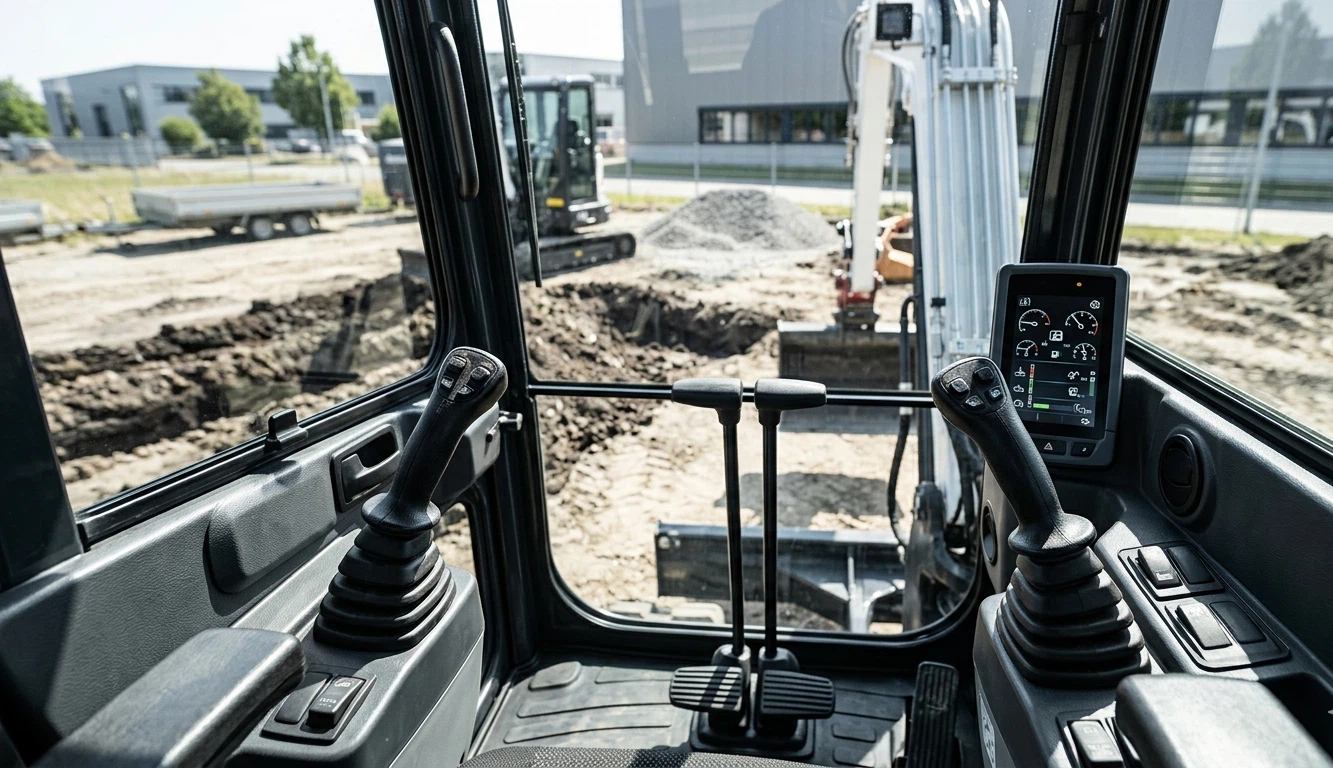
New operators often treat the joysticks like video game controllers, “flicking” the sticks and causing the boom to snap. This is known as “jerky operation,” and it is one of the most common digging mistakes that leads to premature hydraulic failure. To operate mini excavator controls effectively, you must learn the “touch.”
High-speed production isn’t about moving the sticks fast; it’s about overlapping functions. For example, as you are pulling the arm in, you should be simultaneously curling the bucket. This “multi-functioning” reduces the pressure spikes in the hydraulic lines and saves fuel. The best way to operate mini excavator machinery smoothly is to imagine the bucket is an extension of your own hand.
3.The “Trenching Trap”: Neglecting Verticality and Spoil Placement
If you are looking for how to safely operate a mini excavator for beginners, the secret is in the prep work. Beginners often start digging a trench and realize halfway through that the walls are leaning or the trench is “wandering.”
Another rookie move? Dumping the excavated dirt (the spoil) too close to the edge of the hole. This creates immense pressure on the trench wall, leading to a cave-in.
- The Rule of Thumb: Keep the spoil pile at least 2 feet away from the edge.
- Verticality: Always level the machine using the blade before you start. If the tracks are tilted, your trench will be tilted.
4.Skipping the Pre-Start Walkaround (The ROI Killer)
In a B2B or rental environment, the “Pre-Start” is your best friend. Beginners often jump in the cab and start the engine immediately, which is how you miss a leaking hydraulic seal or a loose track. To operate mini excavator equipment profitably, you must treat the asset with respect.
A five-minute walkaround saves five hours of downtime. Check the grease points—dry pins lead to “play” in the boom, making precision work impossible. Also, check the track tension; a de-tracked machine in a muddy pit is a maintenance nightmare.
5.Blind Digging: Ignoring the “811” Compliance
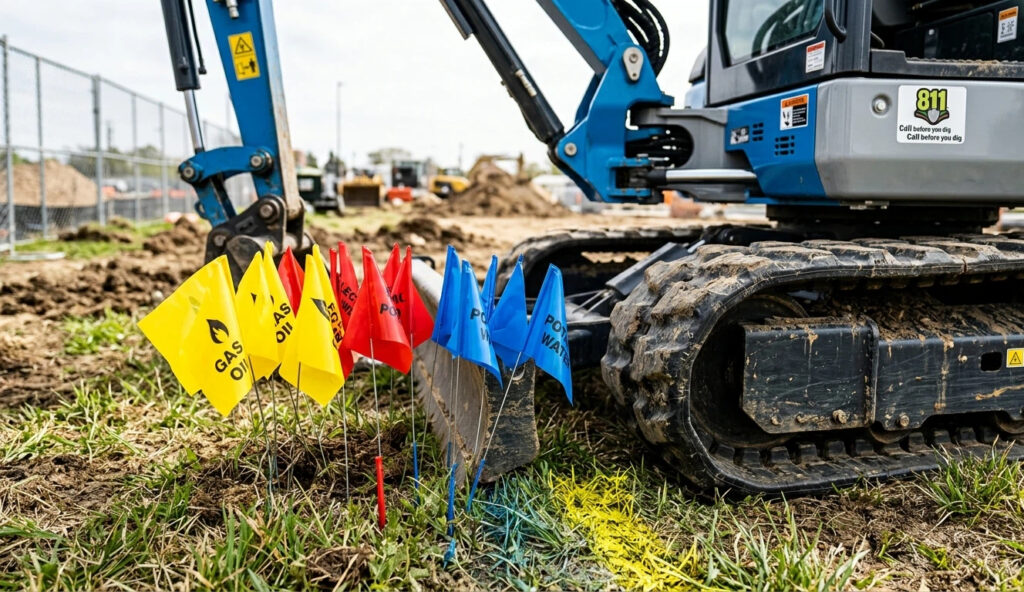
You could be the most skilled operator in the world, but hitting a gas pipe will ruin your career and your budget. One of the most critical beginner excavator tips isn’t about the machine—it’s about the ground. Before you operate mini excavator buckets in any new area, you must call for a utility locate.
In the United States, this is the 811 “Call Before You Dig” service. Beginners often assume that because they are only digging a few feet down, they are safe. This is a fallacy; utility lines can be inches below the surface due to soil erosion.
How to Safely Operate a Mini Excavator for Beginners
If this is your first time in the seat, follow this sequence to build your confidence and muscle memory.
Entry and Stabilization
Always maintain three points of contact when entering the cab. Fasten your seatbelt; in a tip-over, the seatbelt keeps you inside the protective ROPS (Roll-Over Protective Structure). When you operate mini excavator units, the blade should always be your stabilizer. Lower the backfill blade until it firmly touches the ground, lifting the front of the tracks slightly to provide a solid anchor.
Mastering the Joysticks (ISO vs. SAE)
Most modern machines allow you to switch between ISO and SAE control patterns. Ensure you know which one you are using.
- Left Hand: Usually controls the “Swing” and the “Slew” (arm in/out).
- Right Hand: Controls the “Boom” (up/down) and the “Bucket” (curl/dump).
Mini Excavator Operation Tips for Tight Spaces
Working near walls requires a different mindset. This is where “Zero Tail Swing” becomes your best asset. If your machine is a zero-tail-swing model, the rear of the cab does not extend past the tracks when you rotate. However, even then, beginners often forget about the front swing. When you operate mini excavator equipment in tight quarters, always look over your shoulder and keep a spotter nearby.
How to Operate a Mini Excavator on a Slope
If you must move across a slope, follow the “Low and Slow” rule. Keep the bucket as low to the ground as possible. If the machine begins to feel tippy, you can immediately drop the bucket to the ground to stabilize the weight. For detailed stability calculations, refer to the Manufacturer’s Operator Manual, which provides specific degree-of-slope ratings for each model. Driving straight up or down is the only safe way to navigate a grade.
Maintenance and Long-Term Efficiency
Protecting your ROI means understanding that clean trenching requires a sharp, well-maintained bucket. Check your bucket teeth daily. Dull teeth force the hydraulic system to work harder, consuming more fuel and putting unnecessary strain on the pins and bushings.
When you operate mini excavator units for 8+ hours a day, the heat build-up in the hydraulic oil is significant. Ensure the cooling radiators are free of debris. A clean machine is a cool machine, and a cool machine lasts twice as long.
Conclusion
Mastering the ability to operate mini excavator machinery is a journey of muscle memory and situational awareness. The most successful operators are those who never stop being students. They respect the physics of the slope, the power of the hydraulics, and the importance of the 811 locate. By avoiding these five common mistakes—stability errors, jerky controls, poor spoil management, skipping maintenance, and blind digging—you ensure that your time in the cab is productive. It takes time and patience to build the expert “touch” needed to operate mini excavator equipment with true professional mastery.
FAQ
Why does my machine move so slowly when I’m using two functions at once?
This is usually due to hydraulic flow sharing. To operate mini excavator units more efficiently, try easing off one joystick slightly to give more power to the other.
How often should I grease the machine?
Every 8 to 10 hours of operation is the industry standard for the main pivot points. If you are working in water, grease more frequently to push out contaminants.
What is the most important safety feature in the cab?
The safety lockout lever. Never reach out of the cab while the controls are “hot.” Always lift the lever first.