
For any contractor or owner-operator, the workday doesn’t start when you break ground at the job site—it starts the moment the loading ramps drop and your tracks hit the trailer deck. Getting the logistics right for towing mini excavator units might seem like a routine daily task, but it remains one of the highest-risk activities in the construction industry. Between managing a shifting center of gravity and dodging strict DOT inspections, there is absolutely zero room for guesswork.
Improperly secured heavy equipment isn’t just a safety hazard; it’s a massive legal and financial liability. One loose chain, a snapped binder, or an overloaded rear axle can result in catastrophic mechanical failure, wrecked iron, or thousands of dollars in commercial fines. This guide breaks down the harsh, practical realities of equipment transport so you can move your machines with total confidence and zero legal headaches.
Table of Contents
Know Your Limits: The Math Behind the Pull
Before you even look at a hitch, you must understand your truck’s actual, real-world pulling capacity. The process of safely towing mini excavator equipment requires far more than just relying on a powerful diesel engine; you need to calculate your Gross Combined Weight Rating (GCWR). This number represents the absolute maximum allowable weight of your tow vehicle, the trailer, the machine itself, plus all extra attachments (buckets, thumbs, augers) and the fuel in the tank.
A common rookie mistake in the field is forgetting that a “2-ton digger” doesn’t actually weigh 2 tons once you throw on a heavy hydraulic breaker and fill the tank with diesel. Always leave a 15% to 20% safety margin in your weight calculations. If your truck is rated for 10,000 lbs, don’t load it to 9,900 lbs. Pushing the absolute limits of towing mini excavator weights heavily accelerates transmission overheating and leads to terrifying brake fade, especially on steep downgrades.
Selecting the Right Trailer Size for Mini Digger Transport
Choosing the correct trailer size for mini digger hauling is about a lot more than just making sure the tracks fit onto the wood. It comes down to axle capacity, deck height, and load distribution. You can’t just throw a piece of heavy machinery onto a lightweight landscape trailer and hope for the best.
- 1.5t – 2.5t Machines: These machines generally fit on a 10-foot to 12-foot deck. A tandem axle setup (typically rated at 3,500 lbs per axle) is the absolute bare minimum to keep the tires from blowing out.
- 3.5t – 5t Machines: At this weight class, you move into “deck-over” or heavy-duty equipment trailer territory. You’ll need 5,200 lb or even 7,000 lb axles to handle the machine’s weight plus the heavy curb weight of the steel trailer itself.
Ensure the deck length allows you to physically roll the machine forward or backward to fine-tune the tongue weight. If the deck is too short, you simply won’t be able to achieve the correct weight distribution, which is the number one cause of terrifying trailer sway when towing mini excavator rigs down the highway.
The Physics of Loading: The 60/40 Rule
When it comes to loading heavy iron, placement is everything. You want approximately 60% of the equipment’s total weight positioned in front of the trailer’s center axles, and the remaining 40% behind it. This applies the proper “tongue weight” to the hitch of your truck, tying the two vehicles together smoothly.
Too much weight in the rear lifts the back of your truck, leading to “fishtailing,” which can violently flip a rig at 65 mph. Too much weight up front crushes the truck’s rear suspension, causing your front steering tires to lose vital traction on the asphalt.
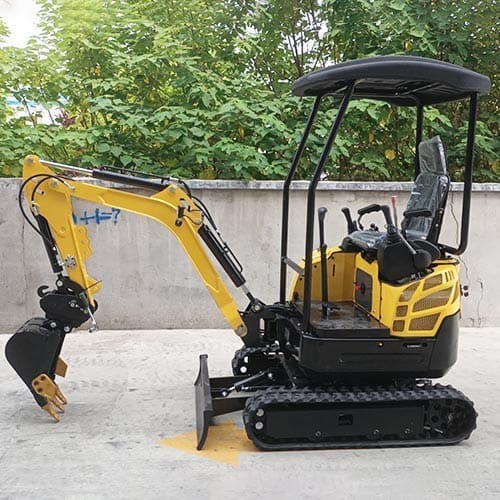
Field Tip: Once you are loaded up on the deck for towing mini excavator transport, immediately drop the boom and ensure the bucket is resting firmly, completely flat against the wood or steel deck. Kill the engine, lock the cab doors, and absolutely make sure to engage the slew lock (swing brake) so the house cannot accidentally rotate while you are taking a sharp corner.
Navigating Legal Tie Down Rules
DOT compliance is strictly enforced by highway patrols, and they love pulling over contractors. Federal tie down rules dictate exactly how many points of contact you must have securing your load. For this specific weight class of machinery, you are legally required to use a four-point tie-down system.
This means four completely independent chains and binders securing the four corners of the undercarriage to the trailer’s rated steel D-rings. Additionally, if you have a digging bucket or a concrete breaker attached to the arm, that specific attachment must be secured with its own separate strap or chain. It cannot just rely on the machine’s hydraulics to stay put.
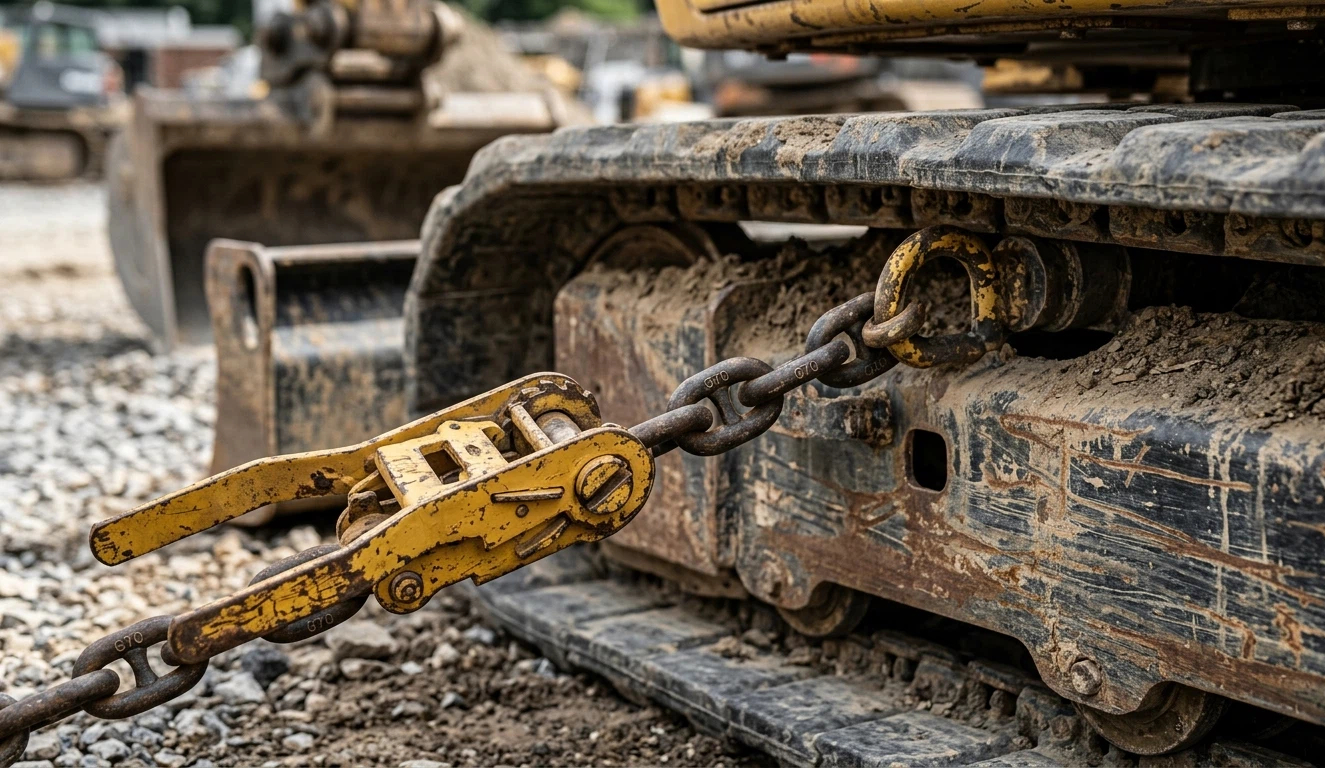
Hardware specs: You must use Grade 70 transport chain. Never, ever use standard hardware store utility chains for towing mini excavator loads; they will snap like twigs under heavy braking force. The combined Working Load Limit (WLL) of your tie-downs must equal at least 50% of the machine’s operating weight, though veteran equipment haulers always aim for a 1:1 ratio for peace of mind.
Step-by-Step: How to Safely Tie Down and Tow a Mini Excavator
If you are breaking in a new operator, or just need a solid refresher for yourself, follow this standard operating procedure on how to safely tie down and tow a mini excavator to avoid DOT fines and roadside accidents:
- Find Flat Ground: Always drop the loading ramps on a level, highly stable surface. Never load on a lateral incline.
- Clear the Ramps: Ensure the ramps are securely pinned and completely free of thick mud, grease, or morning ice.
- The Approach: Crawl up the ramps in low gear. If the machine is particularly heavy, it is often much safer to back it onto the deck so the heavy engine counterweight sits closer to the truck cab.
- Find the Sweet Spot: Once centered (hitting that critical 60/40 mark), lower the front push blade and the boom arm. The aggressive physics of towing mini excavator setups demands the lowest possible center of gravity.
- Hook the Chains: Attach your Grade 70 chains directly to the manufacturer-stamped tie-down points on the track frames. Never loop chains around sensitive hydraulic cylinders or rubber hoses.
- Ratchet Down: Use heavy-duty ratchet binders to pull the chains tight. Avoid older lever binders—they have a nasty habit of kicking back under tension and breaking jaws.
- The Shake Test: Grab a tensioned chain and put your entire body weight into pushing it. If the machine shifts even slightly, you aren’t ready for towing mini excavator speeds yet. Re-tighten every binder.
Equipment Specifications Match-Up
Do not guess your weights. Use this quick reference matrix to accurately match your gear and hauling capacities before leaving the yard.
| Machine Class | Approx. Operating Weight | Minimum Trailer GVWR | Recommended Tow Vehicle |
| 1-Ton Micro | 2,200 – 2,800 lbs | 5,000 lbs (Single/Tandem) | Half-ton Pickup (1500 series) |
| 1.7t – 2.5t Mini | 4,000 – 6,000 lbs | 7,000 – 10,000 lbs (Tandem) | 3/4 Ton Truck (2500 series) |
| 3.5t – 5t Midi | 8,000 – 11,500 lbs | 14,000 lbs (HD Tandem) | 1 Ton Dually (3500 series) |
The Last 60 Seconds: Pre-Trip Inspection
The biggest transport failures happen because an operator got lazy in the last minute of prep. Before you pull out into heavy traffic, walk the entire rig.
- Tires: Check the PSI on the trailer tires with a gauge, not just a kick. Heavy steel loads heat up rubber fast; an under-inflated tire is virtually guaranteed to blow out while towing mini excavator loads on the highway.
- Lights & Brakes: Verify your turn signals, brake lights, and check your in-cab electronic trailer brake controller gain to ensure the trailer will actually stop itself.
- Safety Chains: The trailer hitch chains must be crossed underneath the tongue (acting as a safety cradle in case of a disconnect), and the emergency breakaway cable needs to be clipped directly to the truck frame, never to the hitch loops.
- The Mile-One Stop: After driving your first mile, pull onto the shoulder. Steel chains naturally settle and stretch from road vibration. Re-tighten every single binder.
If you want the exact, indisputable legal text to keep in your glovebox, review and print out the FMCSA Cargo Securement Rules. It is the definitive federal standard that inspectors will grade you against.
Conclusion
Getting iron safely to the job site without incident is the hallmark of a true construction professional. By accurately matching the right trailer size for mini digger hauling with a highly capable tow vehicle, and respecting the raw physics of weight distribution, you protect your crew, your expensive assets, and the general public.
Don’t let a preventable transport mistake wipe out your profit margin for the entire month. Take the time to master the exact steps of how to safely tie down and tow a mini excavator, invest the money to buy the right Grade 70 chains, and religiously double-check your hitch mechanism. When you truly respect the dangerous process of towing mini excavator equipment, you guarantee that the machine arrives safely, ready to dig, every single time.
FAQ
Can I use heavy-duty nylon straps instead of chains?
You can technically use synthetic webbing if it meets the total Working Load Limit, but it is a terrible idea in practice. The sharp steel edges of track frames and undercarriages will easily slice through straps. Strict tie down rules strongly favor using heavy steel chains for any type of tracked machinery.
Do I need a commercial driver’s license (CDL) to haul this gear?
It depends entirely on your total Gross Combined Weight Rating. If your truck and trailer combined are rated over 26,000 lbs, you generally need a CDL. But be incredibly careful: even under that weight limit, if you are doing commercial contracting work, local highway patrols might enforce commercial logbook rules on your towing mini excavator operations.
How do I stop the rubber tracks from sliding on a wet metal deck?
Wet steel-on-steel or rubber-on-steel offers almost zero friction. If your trailer doesn’t have a rough wood deck, you must throw down heavy rubber stall mats or use thick wood blocking firmly wedged under the tracks.