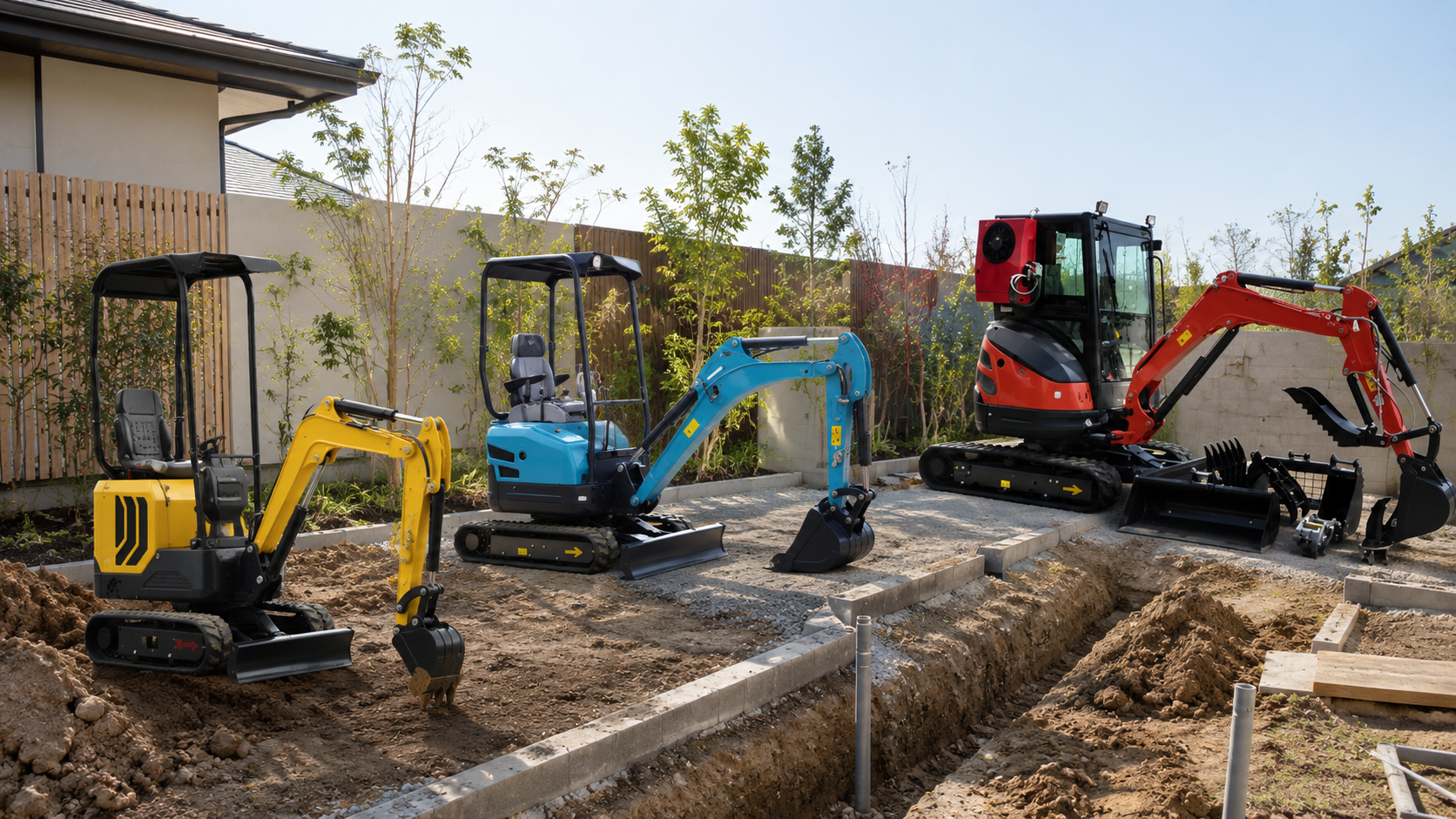
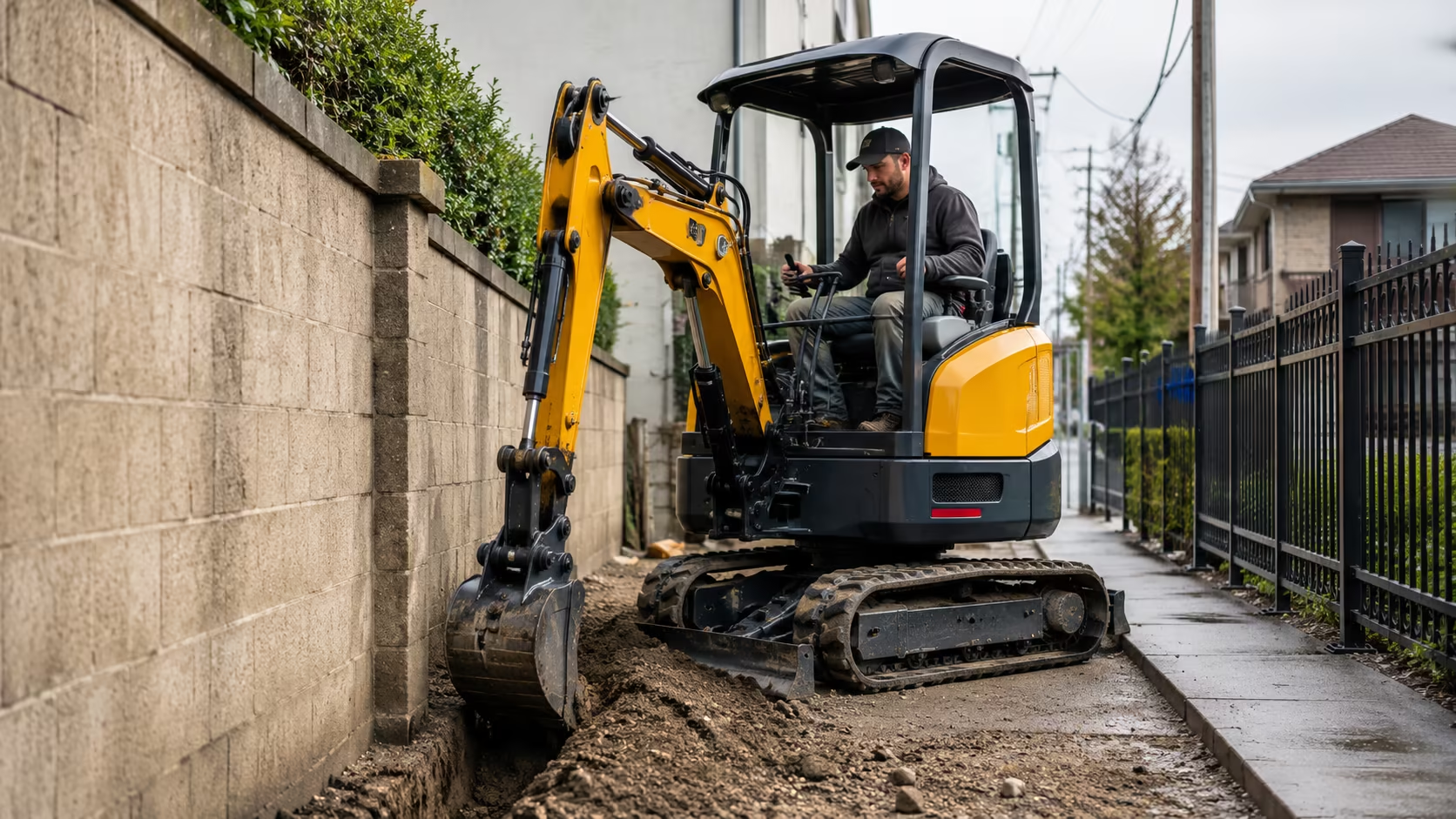
A zero tail swing mini excavator is worth choosing when the real problem is not digging power alone, but space: walls, fences, sidewalks, parked vehicles, garden gates, utility trenches, and urban repair zones. If the rear of a standard machine could hit something while rotating, zero tail swing can save time, reduce damage risk, and make the operator more confident.
This guide explains where this design pays off, where it may not be necessary, and how buyers can match a compact excavator with real jobsite limits instead of choosing by size or price alone.
Table of Contents
What Does Zero Tail Swing Mean on a Mini Excavator?
Zero tail swing means the rear of the machine stays within, or very close to, the width of the tracks when the upper structure rotates. A standard mini digger may need extra rear clearance because the counterweight swings outside the track width. On a narrow job, that difference matters.
The basic excavator layout includes a boom, arm, bucket, and rotating upper structure, as described in the Wikipedia article on excavators. Zero tail swing changes the way that rotating upper structure behaves around nearby obstacles.
A zero tail swing mini excavator is not automatically stronger than a conventional model. Its main advantage is controlled rotation in restricted areas. The operator can swing the house without constantly checking whether the rear corner is about to hit a wall, fence, machine, tree, or parked vehicle.
That is why buyers often search for a mini excavator for tight spaces when they are not sure whether a standard tail design will fit the job.
Where a Zero Tail Swing Mini Excavator Works Best
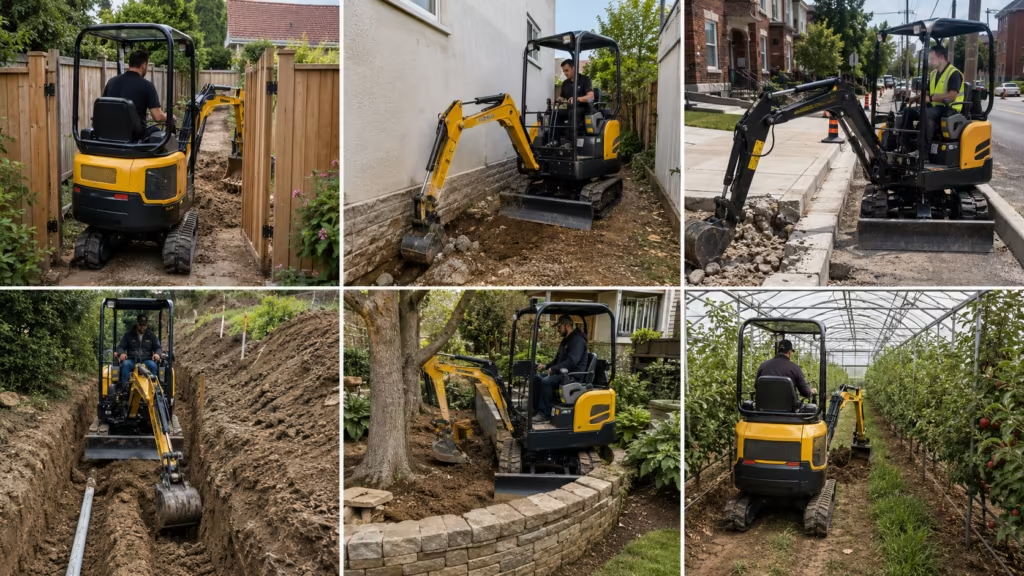
The best jobs for a zero tail swing mini excavator have one common feature: limited room behind or beside the machine.
Common examples include:
- residential yards with fences or narrow access gates;
- wall-side digging around buildings;
- sidewalks, curbs, and roadside repair;
- small drainage and utility trenches;
- landscaping around trees, patios, and retaining walls;
- greenhouse, orchard, and farm path maintenance;
- indoor or semi-indoor demolition where rear clearance is limited.
A tight space excavator is especially useful when the operator must dig, rotate, and dump without repositioning the machine every few minutes. Less repositioning can mean smoother work, fewer ground marks, and lower risk of hitting nearby property.
For a contractor, the value is often practical. One broken fence, damaged wall, or scratched vehicle can cost more than the price difference between two machine configurations.
Why Narrow Job Sites Need More Than a Small Machine
A small machine is not always a safe machine. Machine width tells you whether the excavator can enter the site. Tail swing tells you whether it can work once it gets there.
That is a key difference.
A zero tail swing excavator for narrow job sites helps solve three common problems:
1.Rear collision risk:The operator can rotate closer to walls, curbs, and fences with less rear overhang.
2.Low working efficiency:When a standard machine needs frequent repositioning, the job becomes slower and more tiring.
3.Crowded surroundings:Urban jobs may have pedestrians, vehicles, utilities, cones, barriers, and nearby structures. Tail clearance becomes part of safety planning, not just convenience.
The WorkSafe New Zealand excavation safety guide emphasizes planning excavation work around site hazards. For narrow construction areas, machine movement and access space should be part of that planning.
Wall-Side Digging, Urban Repair, and Backyard Projects
For wall-side digging, the main benefit is confidence. A standard excavator may still do the work, but the operator must constantly manage the rear swing. A zero tail swing mini excavator reduces that concern when working beside houses, retaining walls, garden edges, or commercial buildings.
For backyard projects, access may be the biggest issue. A mini excavator for tight spaces can pass through tighter areas, protect lawns better than larger equipment, and dig around existing landscape features. Still, buyers should check more than tail swing. Width, operating weight, digging depth, bucket size, and ground pressure all matter.
Zero Tail Swing vs Conventional Mini Excavator: Which One Makes More
A conventional mini excavator can still be the better buy when the site is open and the work needs more stability, reach, or lifting support. The point is not that zero tail swing is always better. The point is that the right tail design should match the jobsite.
| Comparison Point | Zero Tail Swing Design | Conventional Tail Design |
|---|---|---|
| Rear clearance | Best for tight spaces | Needs more swing room |
| Wall-side work | Easier and safer to manage | Higher chance of rear contact |
| Open site digging | Works well, but may not be necessary | Often cost-effective |
| Lifting feel | Depends on weight and design | Rear counterweight may help |
| Best fit | Urban, backyard, landscaping, narrow access | Open digging, heavier small jobs |
The ForConstructionPros article on reduced, zero, and conventional tailswing excavators makes a useful point: the best configuration should come from jobsite evaluation, not from a single feature name.
A zero tail swing mini excavator is the smarter choice when rear clearance is a daily problem. A conventional model can still make sense when the machine has plenty of working space.
Is a Zero Tail Swing Mini Excavator Worth the Extra Cost?
A zero tail swing mini excavator is worth the extra cost when it prevents delays, rework, or damage on cramped sites. The value is strongest for contractors who work on many small jobs rather than one open jobsite.
It is usually worth considering if you often work on:
- residential landscaping;
- fence-line trenching;
- small utility repair;
- city sidewalk maintenance;
- drainage jobs beside walls;
- property renovation;
- greenhouse or orchard paths;
- tight-access demolition.
The machine does not need to be the biggest compact excavator on the quote sheet. It needs to be the one that can enter the site, rotate safely, dig to the required depth, and carry the right bucket or attachment.
If you are comparing Huaying models, you can start with these compact excavator options for narrow job sites and then check operating weight, width, digging depth, bucket capacity, canopy or cab choice, and attachment compatibility.
What Should Buyers Check Before Choosing a Tight Space Excavator?
A tight space excavator should be selected by jobsite measurements, not by photos alone. A zero tail swing mini excavator still needs the right width, depth, and hydraulic capacity for the work.
Before buying, check these points:
- narrowest gate or access width;
- working width after the machine reaches the site;
- tail swing radius;
- boom swing availability;
- maximum digging depth;
- bucket capacity and bucket width;
- lifting capacity at working radius;
- ground pressure on lawns or soft soil;
- transport weight and trailer limit;
- auxiliary hydraulic flow for attachments;
- service access and daily maintenance points.
For utility or drainage jobs, underground services must also be considered. The 811 Before You Dig guide explains that anyone planning to dig should contact 811 or the local state 811 center before digging so buried utilities can be marked. This is especially relevant for small urban and residential jobs where gas, water, telecom, or electrical lines may run close to the work area.
A zero tail swing mini excavator helps with physical clearance, but it does not remove the need for site marking, safe trenching, or operator awareness.
Match Tail Swing with Machine Size Before You Buy
Tail design is only one part of the decision. A 1 ton machine may enter a narrow garden, but it may not have enough digging depth for a serious drainage job. A 3 ton machine may dig faster, but it may be too wide or heavy for a small residential site.
If you are still comparing 1 ton, 2 ton, and 3 ton machines, this guide on how to choose the right mini excavator size can help you match machine weight, access width, digging depth, and job type before choosing a zero tail swing model.
As a simple rule:
- choose 1–1.5 ton when access and transport are the main limits;
- choose 1.8–2.5 ton for balanced landscaping, drainage, and utility work;
- choose 3–3.5 ton when depth, stability, and productivity matter more.
A zero tail swing mini excavator makes the most sense when the chosen size also fits the access path, ground condition, and digging requirement.
When a Zero Tail Swing Mini Excavator Is Not Necessary
A zero tail swing mini excavator is not necessary for every buyer. If the work is mostly in open fields, wide construction lots, large foundations, or open farm areas, rear clearance may not be the main problem.
A conventional mini digger may be enough when:
- the machine has plenty of room to rotate;
- the job needs more lifting support;
- budget is the top priority;
- deep trenching matters more than compact rotation;
- the operator rarely works near walls, fences, or traffic.
This honest comparison matters because buyers should not pay for a feature just because it sounds modern. The right machine is the one that removes the biggest limitation on the job.
Conclusion
A zero tail swing mini excavator is worth choosing when the jobsite is narrow, crowded, or close to walls, fences, traffic, or finished property. It is not just a compact excavator feature; it is a practical way to reduce rear-swing risk and keep small jobs moving.
For open sites, a conventional mini digger may still offer better value. For tight residential, landscaping, utility, and urban maintenance work, the zero tail swing mini excavator can be the difference between “the machine fits” and “the machine actually works safely once it gets inside.”
FAQ
What is a zero tail swing mini excavator?
It is a compact excavator designed so the rear of the upper body stays within, or very close to, the track width during rotation. This helps when working near walls, fences, vehicles, or tight paths.
Is zero tail swing worth it?
Yes, if your jobs often involve narrow access, urban repair, backyard work, landscaping, or wall-side digging. It may not be necessary for open sites.
What is the difference between zero tail swing and standard tail swing?
Zero tail swing needs less rear clearance when rotating. Standard tail swing usually has more rear overhang and needs more open space behind the machine.
Is a zero tail swing model good for backyard projects?
Yes. It is useful for backyards with fences, trees, patios, walls, and narrow access. Always check width, ground pressure, and digging depth before choosing.
Can it dig as well as a standard mini excavator?
It can handle many of the same tasks, but performance depends on machine weight, engine power, hydraulic flow, bucket size, digging depth, and lifting capacity.
What size mini excavator is best for tight spaces?
For very narrow access, 1–1.5 ton models are common. For more balanced digging and stability, 1.8–2.5 ton machines are often more practical.